 |

12 Jan 2026
Optical contrast technique could assist surgeons during removal of malignant tissue.
Thyroid cancer is the most common endocrine cancer, and a number of optical techniques have been developed to assist clinicians in its diagnosis and treatment.Examples include the use of near-IR diffuse spectroscopic methods and hybrid laser/ultrasound platforms developed by Spain's ICFO laboratory to monitor thyroid health.
A particular concern for clinicians is the importance of distinguishing healthy from malignant tissue in real time, to ensure successful removal of all necessary tissue and avoid the need for subsequent repeat procedures.
Now a project at Duke University and UCLA has developed a technique for label-free optical imaging of thyroid tissues and machine-learning analysis of the data.
Published in Biophotonics Discovery, the method should assist real-time, non-invasive tumor classification and margin assessment.
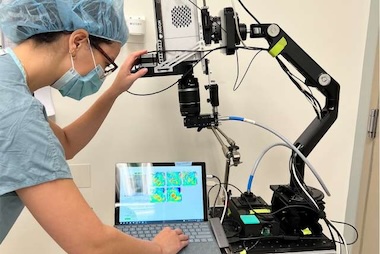
The procedure is based around dynamic optical contrast microscopy (DOCI), a technique in development at UCLA since 2016. It employs a high-speed camera and LED light to delineate margins between malignant and healthy tissue, without the use of injectables or dyes.
DOCI exploits the autofluorescence found in thyroid tissues, and expands the principle of fluorescence lifetime imaging to collect information from 23 different optical channels. This allows it to characterize tissue by measuring combined autofluorescence decay behavior, noted the project in its paper.
"Human tissues contain numerous endogenous fluorophores, and their distinct decay signatures allow DOCI to noninvasively assess variations in tissue composition. By leveraging the fluorescence lifetime of various endogenous fluorophores, DOCI generates a distinct molecular map to aid in identifying cancer margins."
Highlighting cancerous regions in tissues
The other element in the new method is a machine-learning framework designed to classify thyroid tissue subtypes and segment cancerous regions from ex vivo hyperspectral sections, an AI approach with potential for real-time surgical use.
In trials on ex vivo thyroid specimens, the project's machine learning model characterized each specimen as being healthy thyroid tissue, follicular thyroid cancer or papillary thyroid cancer. By distilling the 23 DOCI optical channels into a small set of key features, the system accurately classified samples across these categories and achieved perfect accuracy on an independent test set, according to the team.
Notably, the model also correctly identified samples from the highly aggressive anaplastic subtype as cancerous, demonstrating a broad sensitivity to malignant tissues.
A further deep-learning model designed to identify and map specific regions within medical images was then able to generate probability maps accurately highlighting cancerous regions, with particularly strong performance for papillary thyroid cancer, and very low false-positive rates in cancer-free tissue.
DOCI and the merging of optical imaging with AI has the potential to reduce uncertainty in the operating room, prevent unnecessary surgeries, spare healthy tissue, and improve outcomes for patients, commented the project. The key next step will be to translate the technique towards real-time use during surgery.
"Expanding DOCI to in vivo or near-real-time imaging scenarios, coupled with on-device machine learning, may pave the way for next-generation optical guidance tools in head and neck surgery," said the project in its paper.
 |  |  |  |  |  |  |
| © 2026 SPIE Europe |
|