 |

22 Dec 2025
Aiming to transition laser-ignited inertial fusion from experimental to industrial stage.
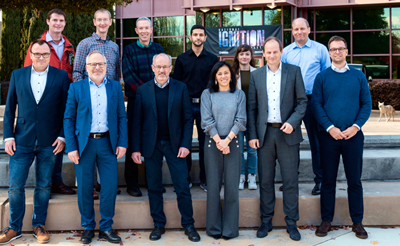
Two world-leading research institutions are joining forces and their laser design and simulation expertise – to successfully transition laser-ignited inertial fusion from the experimental stage to industrial application. In the project ICONIC-FL (International Cooperation on Next-gen Inertial Confinement Fusion Lasers), Lawrence Livermore National Laboratory (LLNL) and Fraunhofer Institute for Laser Technology (ILT), Germany, are collating their laser simulation models.Their aim is the development of high-energy lasers that can ignite a fusion reaction and will run at maximum efficiency in 24/7 power plant operation. This requires precise and highly accurate predictions of laser performance, which is why powerful computer simulations play a central role in the development of laser architecture.
From experiment to power plant
At the National Ignition Facility (NIF), the engineers focused on addressing plasma physics issues, such as the conditions required to heat the fusion fuel deuterium-tritium to over 100 million degrees, compress it extremely, and trigger a self-sustaining fusion reaction. When this occurs, more energy is released than introduced into the fuel capsule – the target – from outside by lasers. Since its breakthrough at the end of 2022, LLNL has demonstrated that the physical principle works, several times and with increasing energy yield.
A single ignition, however, will not be sufficient for a future power plant. Rather, the plant will require approximately 15 shots per second. This requires the use of efficient diode-pumped solid-state lasers that can fire dozens of times per second.
Two laser heavyweights, LLNL and ILT, are now pooling their complementary expertise to develop these lasers: while LLNL brings along decades of experience in high-energy laser technology to the table, the Aachen-based institute is a global leader in the development and industrial scaling of DPSSLs.
The laser design must be validated in simulations before expensive prototypes can be built. In the ICONIC-FL (International Cooperation on Next-gen Inertial Confinement Fusion Lasers) project, the partners are pursuing the common goal of simulating the amplification stages of high-energy lasers in as much detail as possible—thus laying the foundation for a later design.They are focusing on the heart of the system: the laser amplifiers. These amplify an initially small laser pulse to the laser energies required for fusion. In these laser pulses, the photons transfer an energy of many millions of joules.
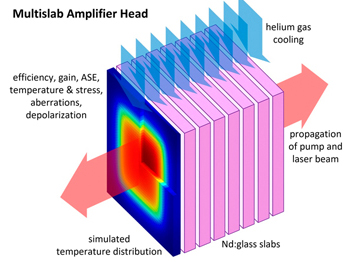
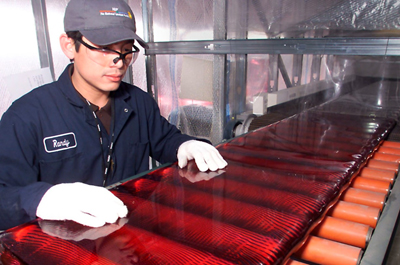
Laser media used for this purpose consist of stacks of laser glass or crystal plates with an area of up to 40x40 cm and a thickness of a few millimeters; they are cooled with transparent cooling media during operation. The amplifier plates are exposed to enormous thermal and optical stress.
“24/7 operation leads to heating, refraction effects, and aberrations that could distort the laser beam. Even the smallest, unpredictable effects are significant here and lead either to efficiency losses or direct damage to the optics,” said Johannes Weitenberg, project manager at Fraunhofer ILT.
Independent cross-validationIn the ICONIC-FL research project, the partners will diligently collate their respective simulation solutions, which they have developed over many years, to achieve increasingly detailed and realistic simulations. They will systematically compare and cross-validate simulations without exchanging the actual code.
“It’s not about merging the simulation models, but about learning from each other and double-checking our results,” said Weitenberg. Nevertheless, this methodical approach is extremely valuable from a scientific, technical, and economic perspective. The partners can guarantee that their simulated predictions are extremely robust and reliable by independently applying their respective codes to the same design.
Dr. Tammy Ma, head of fusion research at LLNL, said, “The transition from basic research to power plant development requires the rapid, robust development of rugged new laser systems rapidly. ILT’s expertise in the industrial scaling of diode-pumped lasers is crucial for accelerating our IFE program.”
Prof. Constantin Häfner, Executive VP Research and Transfer at Fraunhofer, said, “For inertial fusion to reach its full potential, we need to develop new laser architectures with uncompromising perfection. Combining the expertise of LLNL with the industrial scaling expertise of Fraunhofer and its institute ILT is a powerful response to this challenge.”
 |  |  |  |  |  |  |
| © 2026 SPIE Europe |
|