 |
 |

...plus Photonics21 launches €5000 Innovation Award – sponsored by SPIE Europe and Hamamatsu.

Optical component and infrared camera vendor aiming to add cash with sale of nearly 8 million shares.
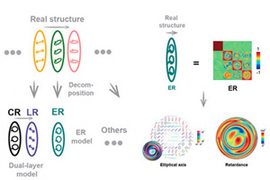
Elliptical retarder model improves polarization analysis for material design and biomedical imaging.
Automotive lidar pioneer recently lost a major supply deal with lead customer Volvo.

Quick test for E. Coli uses laser-based flow cytometry and machine learning.
Using laser-cooled Rb atoms and atomic interferometry to measure gravity precisely.
 16 Dec 25 |
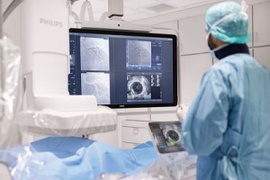
Philips snaps up intravascular imaging pioneer SpectraWAVE US startup combines optical coherence tomography with near-infrared spectroscopy to aid coronary artery interventions. |
 16 Dec 25 |
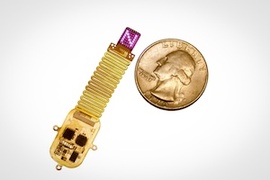
Northwestern University implant activates neurons with micro-LED array Patterned bursts of light could help rehabilitation and pain relief. |
 15 Dec 25 |
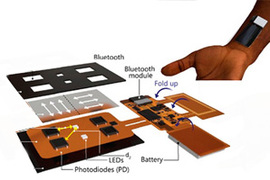
Polarized light boosts accuracy of wearable health sensors for all skin tones Brown University’s approach addresses PPG signal quality at level of light-tissue interaction. |
 11 Dec 25 |
Dutch group discovers ‘light-bending’ material for blue and UV light 2D ferroelectric material “CIPS” can direct blue and ultraviolet light – notably for chip-making applications. |
 10 Dec 25 |
Syntec order book suggests rapid growth for satellite optics Rochester-based optics firm says it can meet the rigorous demands of a rapidly growing application area. |
 10 Dec 25 |
Cambridge spin-out Nu Quantum raises $60M in series A round Oversubscribed funding round thought to be the largest ever for a pure-play quantum networking company. |
Oxford Instruments Andor

Resolve Optics Ltd

Master Bond Inc.
Hamamatsu Photonics Europe GmbH
 | Surface Quality Control for Maximizing LIDT in High-PowerLaserOptics 06 Oct Optoman in collaboration with Dioptic In high-power laser systems, the optical components' resilience to laser-induced damage directly determines performance, reliability, and service life. Even minor surface or subsurface imperfections can severely compromise the laser-induced damage threshold (LIDT), introducing failure points that limit system capability. |
 | Choosing the best spectrometer for NIR OCT 02 Apr Wasatch Photonics Near infrared optical coherence tomography has traditionally been limited to imaging depths of just a few millimeters, but with our expanded line of OCT spectrometers, up to 12 mm is possible. In this tech note, we explore and compare three different drop-in spectrometer models designed to serve a wide range of resolution, depth, and size requirements in NIR OCT imaging. |
 | Transforming Laser Material Processing: Digital Beam Shaping for High Power Lasers 10 Dec Hamamatsu Photonics Europe Hamamatsu Photonics has advanced LCOS-SLM technology to enable dynamic digital beam shaping for high-power lasers. Thermal innovations like sapphire glass and water-cooling boost precision, efficiency, and multi-beam capability, raising power tolerance to 750 W. Ideal for applications such as laser powder bed fusion, Hamamatsu delivers flexible, high-throughput solutions compatible with AI systems, setting new standards in optical beam shaping |
 | Identifying Optical Materials with Precision Accuracy 04 Mar Knight Optical Precision accuracy is a critical necessity with any optical component. Rigorous testing to ensure strict compliance with given requirements will always be essential; it is a vitally important demand within any industry sector. Dimensional, surface profiling and optical performance testing are significant aspects of this process, but an additional layer of assurance and quality can be achieved with the use of material verification, employing methods such as refractive index, density testing and transmission measurement. This White Paper explores advanced techniques for precise optical material verification, overcoming the limitations of traditional testing methods. |











 |
| © 2025 SPIE Europe |
|