


Exail quantum gravimeters delivered to Tenerife for volcano monitoring
Using laser-cooled Rb atoms and atomic interferometry to measure gravity precisely.
16 December 2025 Photonics Applications News
 Exail, a global company focusing on photonics and quantum technologies, has delivered three of it Absolute Quantum Gravimeters (AQGs) to the Canary Islands Volcanological Institute ("INVOLCAN"). The company states that the acquisition "marks a major step forward for monitoring volcanic activity in Tenerife-one of Europe's most active regions-and confirms [our] ability to deploy industrial-grade quantum sensors for critical missions".
Located on some of the most closely studied volcanic systems in the world, the Canary Islands, which are Spanish territories, remain exposed to direct risks affecting their 2.3 million residents as well as the many visitors they receive each year.
Related news: Exail to build ultra-stable laser for gravitational wave observatory.
Since 2016, Tenerife has experienced a gradual increase in signs of volcanic unrest, marked by rising seismic activity and enhanced gas emissions from Mount Teide, Europe's highest volcano, standing at 3,715 meters. In this context, says Exail, "strengthening measurement instruments is essential to improving the authorities' ability to anticipate emerging hazards."
Measuring gravity variations
Integrated into INVOLCAN's monitoring network, the first Exail's AQG will be installed at the north-west edge of Tenerife, complementing existing geophysical instruments. Their ability to detect extremely small gravity variations linked to underground mass movements will enable more detailed tracking of magmatic system dynamics and enhance the reliability of real-time assessments. Two additional installations are planned in the coming months.
Luca d'Auria, volcanologist and Director of the Volcanic Surveillance at INVOLCAN, commented, "We are excited about this relevant improvement in the volcano monitoring program of INVOLCAN in the Canary Islands. Thanks to the financial support of the Spanish Ministry of Science and Innovation, we achieved this new milestone, positioning Tenerife at the forefront of volcano monitoring from both scientific and technological perspectives."
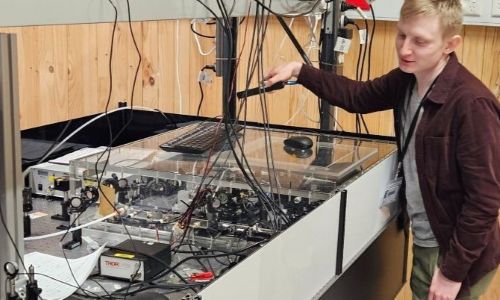
Exail's AQGs rely on atomic interferometry to measure gravity with a high level of precision. Leveraging quantum technologies - rubidium atoms trapped andmanipulated with lasers in vacuum - these instruments deliver long-term gravity time series without the drifts that affect conventional gravimeters and maintain performance even under challenging environmental conditions. With no moving mechanical parts, no instrumental drift, and no maintenance requirements, they can ensure real-time insights for continuous monitoring and early-warning systems.
"We are proud to see Exail's quantum gravimeters supporting volcano monitoring in the Canary Islands, following more than 20 units already deployed worldwide - including on Mount Etna since 2020," said Nathalie Olivier, Sales Director Quantum Sensors & BDM Navigation and Motion simulation systems.
"This milestone confirms the growing adoption of quantum gravimeters in geoscience and highlights Exail's unique ability to deliver multiple industrial-grade instruments in a field where most solutions remain experimental. It reinforces our commitment to helping scientists and authorities better protect populations exposed to volcanic risks," she said.
Exail will support INVOLCAN throughout the deployment of the three systems and their integration into the institute's alert framework. This collaboration is fully aligned with Exail's ambition to bring quantum technologies to operational maturity, serving essential applications ranging from volcano monitoring to climate and Earth-system observation.
Diffraqtion aims high with $10M for 'quantum' camera platform
September 01 2026