 |

24 Dec 2025
Imaging of lab clouds shows features key to rainfall and brightness in atmospheric modeling.
Scientists at the U.S. Department of Energy’s Brookhaven National Laboratory (BNL) and collaborators have developed a new type of lidar that can observe cloud structures at the scale of 1 cm. The scientists have used the lidar to directly observe fine cloud structures in the uppermost portion of laboratory-generated clouds.This capability for studying cloud tops with resolution that is 100 to 1,000 times higher than traditional atmospheric science lidars enables pairing with measurements in controlled chamber experiments in a way that has not been possible before.
The results, published in Proceedings of the National Academy of Sciences, provide some of the first experimental data showing of how cloud droplet properties near the tops of clouds differ from those in the cloud interior. These differences are crucial to understanding how clouds evolve, form precipitation, and affect Earth’s energy balance.
“This is the first time we’ve been able to see these cloud-top microstructures directly and non-invasively,” said Fan Yang, an atmospheric scientist at BNL and lead author. “These structures occur on scales smaller than those used in most atmospheric models, yet they can strongly affect cloud brightness and how likely clouds are to produce rain.”
The new lidar was constructed by Yong Meng Sua of the Stevens Institute of Technology, working with BNL. It uses time-correlated single-photon counting — a technique capable of detecting individual photons backscattered from clouds by ultrafast laser pulses. Data-sampling algorithms use the photon signals to reconstruct detailed profiles of cloud structure with centimeter precision.
At the heart of the system is a custom-built laser and a photon-counting detector. The laser sends out ultrashort pulses of light at high repetition rates, and the detector records the arrival time of the very first photon scattered back from cloud droplets. Measuring millions of these return photons per second produces a finely resolved picture of cloud droplet distribution along the laser beam.
Cloud chamber experiments“This lidar is essentially a microscope for clouds,” Yang said. “Because we designed the lidar ourselves, we were able to optimize everything — from the laser system to the timing electronics — to achieve the centimeter-scale resolution needed to study cloud physics in a totally new way.”
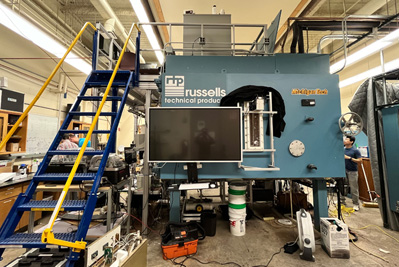
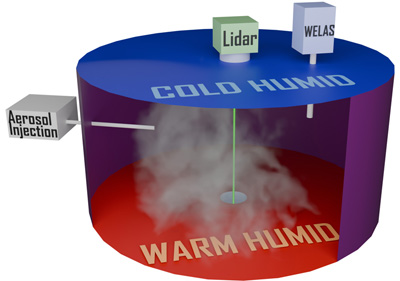
The BNL team tested the tool on well-characterized clouds in a cloud chamber at Michigan Technological University. The lidar measurements revealed that the distribution of cloud droplets at the top of the cloud varied significantly from the more uniform structure making up the bulk of the cloud. They found fewer cloud droplets near the top of the laboratory-generated clouds than in the bulk region.
According to the scientists, this reduction of cloud droplets near the cloud top is due to two processes: entrainment, where clear dry air above is drawn downward into the cloud, diluting the cloud and causing some droplets to evaporate; and “size sorting” due to sedimentation, where heavier droplets fall faster than lighter ones.
“In the bulk region of a cloud, turbulence is typically strong,” Yang said. “This strong turbulence allows cloud droplets of different sizes to mix efficiently and remain relatively uniformly distributed, or homogenous.”
Near the top of the cloud, however, turbulence is weaker, so only the smaller droplets stay suspended in the airflow while heavier ones settle out. This size sorting effect results in fewer drops and a more layered structure with local variations.
“Many atmospheric models either neglect droplet sedimentation altogether or represent droplets of different sizes with a single fall speed,” Yang said. “An inaccurate representation of cloud-top physics can introduce substantial uncertainty into model predictions of how clouds reflect sunlight and trigger rainfall.”
The Brookhaven scientists plan to expand these studies in a new cloud chamber just constructed at the lab. “Having a cloud chamber at Brookhaven dramatically expands what we can do,” Yang said. “It allows us to iterate more quickly, validate new sensors as we build them, and deepen our understanding of cloud processes that are nearly impossible to isolate in nature.”
Beyond providing finer scale information for improving atmospheric models, these findings will also help improve measurements in the actual atmosphere. For example, cloud chamber measurements with the new high-resolution lidar can be used to ensure that atmospheric-sampling lidars using the same technique, including a T2 lidar built by the Brookhaven team to study cloud characteristics near the cloud base, are accurately calibrated.
 |  |  |  |  |  |  |
| © 2026 SPIE Europe |
|