


CUNY metasurface turns infrared into steerable visible light
Nanoscale nonlinear device changes color and direction of light using a single surface.
04 February 2026
Researchers from the Advanced Science Research Center at CUNY Graduate Center (CUNY ASRC) have made a breakthrough in the design of nonlinear metasurfaces.
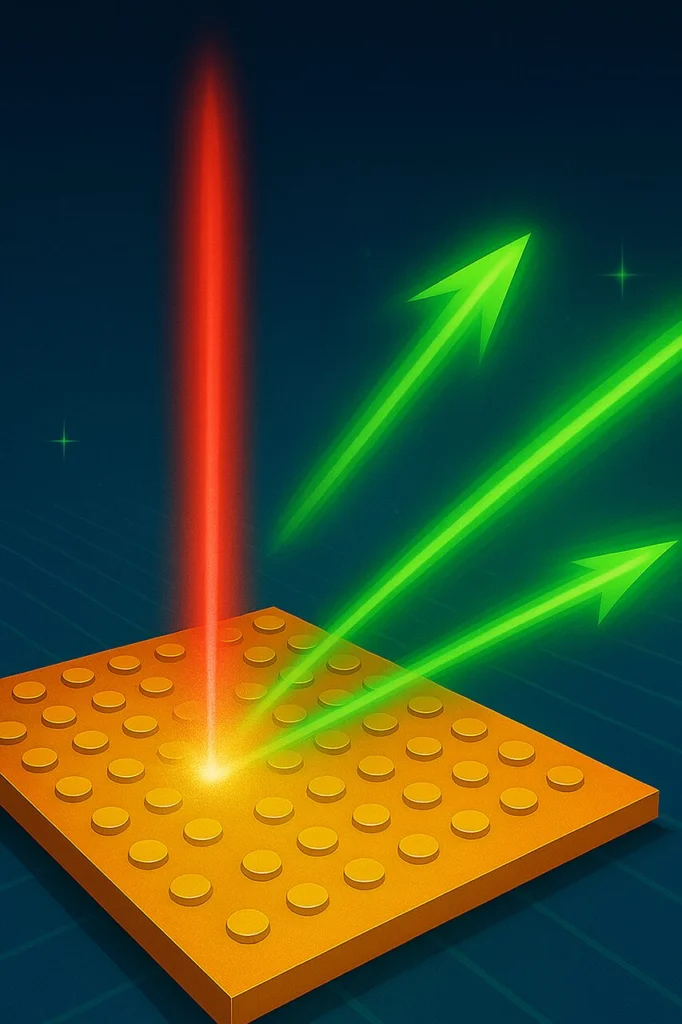
Described in eLight, the team's device is a metasurface that can turn invisible infrared light into visible light, and aim it in different directions without any moving parts.
Metasurfaces in which nonlocal light-matter interactions take place are a potentially useful variant of traditional metasurfaces, whose nanoscale surface features have novel effects on incident light. To date, however, control of a nonlinear wavefront on a metasurface has proven to be more difficult than in conventional versions.
If the properties of a nonlinear metasurface could be suitably tailored, it might combine the wavefront shaping abilities of traditional metasurfaces with the enhanced light-mater interaction promised by nonlinear properties. CUNY set out to see if this was possible.
In the project's device, each unit cell of the surface consists of two rectangular apertures, rotated by 90 degrees relative to each other. When incident light arrives, nonlocal effects at the surface change the wavelength of the light through third-harmonic generation, and the light is emitted as a different color.
In addition the surface is excited from below by a pump light source supplying circularly polarized light. Changes to the polarization of the pump cause changes to the direction of the emission from the metasurface, effectively offering some beam steering capability in addition to the wavelength change.
Components for lidar, quantum light generation and signal processing
In trials the device converted 1530-nanometer infrared light into visible green light near 510 nanometers and steered it to chosen angles.
"Think of it as a flat, microscopic spotlight that not only changes the color of light but also points the beam wherever you want, all on a single chip," said Andrea Alù, founding director of the CUNY ASRC Photonics Initiative. "By making different parts of the surface work together, we get both very efficient conversion of light and precise control over where that light goes."
This could help tackle a long-standing trade-off in metasurfaces, according to CUNY. Usually structures that control light at each pixel of the surface are flexible but not very efficient at boosting light, while structures that allow light waves to spread and interact across the whole surface can be very efficient, but lose fine control over the beam shape.
"The new CUNY device is the first to do both at once for nonlinear light generation, in which one color of light is converted into another," said the project.
"It uses a special kind of collective resonance to trap and amplify the incoming infrared light across the entire surface. At the same time, each tiny building block on the surface is rotated in a carefully designed pattern, giving the outgoing light a position-dependent phase, like a built-in lens or prism."
The research opens a path to ultra-compact light sources and beam-steering elements for technologies like lidar, quantum light generation and optical signal processing, all integrated directly on a chip, according to Michele Cotrufo from CUNY.
"Because the concept is driven by geometry, not by one specific material, it can be applied to many other nonlinear materials and across different colors of light, including the ultraviolet."
CUNY metasurface turns infrared into steerable visible light
February 04 2026
Metasurface in contact lenses corrects color blindness
March 10 2020
Diffraqtion aims high with $10M for 'quantum' camera platform
September 01 2026