


University of Strathclyde creates high-performance lenses from consumer 3D-printers
Fabrication approach could bring advanced, customizable imaging within reach of more researchers.
14 January 2026
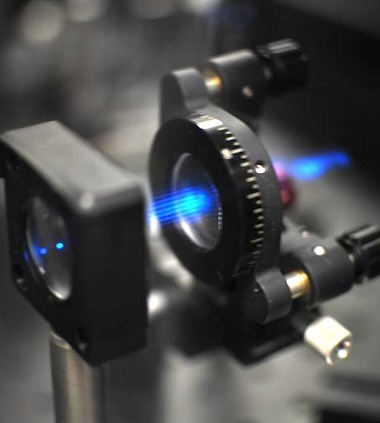
High-end optical methods such as super-resolution microscopy exploit the properties of advanced components and lenses, but these items can be expensive to source and maintain.
Creating optomechanical components through 3D-printing has been explored as a way around this constraint, and the additive manufacturing methods being employed have themselves become increasingly sophisticated.
A project at the University of Strathclyde has now shown that consumer-grade 3D printers and low-cost materials can be used to produce multi-element optical components that enable super-resolution imaging, with each lens costing less than $1 to produce.
Published in Biomedical Optics Express, the findings point to cost-effective platforms being made available to a broader range of research projects.
"We created optical parts that enable imaging of life's smallest building blocks at a remarkable level of detail," commented Strathclyde's Jay Christopher.
"This approach opens the possibility for customized imaging systems and unlocks imaging scenarios that are traditionally either impossible or need costly glass manufacturing services."
The team's lens design and manufacturing processes, combining 3D printing, silicone molding and a UV curable clear resin, builds upon earlier work in which Strathclyde showed that consumer-grade 3D printers and materials could be used to create basic lenses identical to factory-produced optics. These lenses were among those used to produce a fully 3D-printed microscope.
Accessing tools previously locked behind expensive technology
For the new work, researchers wanted to make inexpensive lenses with a consumer-grade vat photopolymerization printer, and use them in a multifocal structured illumination microscope (SIM). This uses patterned light at multiple focal points to illuminate a sample, capturing multiple images that are computationally combined to reveal details smaller than the normal diffraction limit.
A key challenge was reducing the optical scattering observed when focusing a laser through a 3D-printed lens. This scattering occurs because the lens is printed layer-by-layer using a pixelated screen, which can lead to unwanted diffraction effects in the lens.
The new approach involves an initial 3D-printing of a raw optic with a "staircase" effect in which the layers are equal to the chosen axial resolution, which is then spin-coated with clear resin. To enhance the clarity and transparency, more of the 3D printing material is attached to each lens surface to smooth out the thin layers.
This additive approach, which is much quicker than the traditional approach of polishing, created a custom-designed lens with surfaces smooth enough to compete with commercial-grade glass lenses.
In SIM trials, a lenslet array was created through the new approach for comparison to high-end and budget commercial optics. The 3D printed optical lens array was used in a prototype multifocal structured illumination microscope, and observed super-resolution biological data that was nearly identical in quality to that acquired with commercial glass lens arrays, according to the project.
The approach could now be used to produce multiple focused points in three dimensions, to explore bio-inspired imaging and sensing designs or to combine different materials to make single, affordable components that combine transparent and opaque features for added functionality.
"Our new approach could empower scientists and companies to access tools previously locked behind specialist technology with high costs," said Jay Christopher. "Using budget-friendly 3D printers and materials, they could manufacture their own components to solve problems they are facing and, in turn, generate unique research and product development solutions."
Scottish laser innovation center receives £8M from UK Government
December 09 2025
Leica and Cognex launch AI software module Aivaro to improve inspection
September 30 2026
Photonic monitoring to identify food safety, quality, and animal welfare
September 30 2026
Advances in optics and computation boost coronary intravascular imaging
September 30 2026
Australia’s SKA tests antenna layout for Low telescope
September 30 2026