


Japan group develops room-temperature CW UV-B laser diode on sapphire
Meijo University’s semiconductor source promises compact medical, biotech, and manufacturing tools.
15 January 2026
Ultraviolet-B (UV-B) semiconductor lasers are required for medical, biotechnology, and precision manufacturing applications; however, for a long time UV-B laser diodes have been limited to pulsed operation or required cryogenic cooling, making continuous room-temperature operation unattainable.
Now researchers in Japan have reported the world’s first continuous-wave UV-B semiconductor laser diode operating at room temperature on a low-cost sapphire substrate. This breakthrough by researchers at Meijo University advances compact, energy-efficient UV light sources, potentially replacing bulky gas-based lasers.
To provide ultraviolet-B (UV-B) radiation, which lies between visible light and shorter-wavelength ultraviolet radiation, semiconductor laser diodes offer an attractive alternative to the longstanding UV sources such as gas lasers or complex optical setups. Those have typically been large, costly, and difficult to integrate.
Semiconductor sources are compact, energy-efficient, and well-suited for mass production. However, extending semiconductor laser technology into the UV-B range has proven extremely challenging. High aluminum-content nitride semiconductors, which are required to generate UV-B light, suffer from crystal defects, poor optical confinement, and severe heat dissipation issues.
Overcoming ‘long-standing challenges’
As a result, previous UV-B laser diodes were limited to pulsed operation or required cryogenic cooling to operate stably. Prof. Motoaki Iwaya from the Department of Materials Science and Engineering, Meijo University, Japan, and his team have overcome these long-standing challenges. The findings of the group’s study were published in Applied Physics Letters on January 12th.
The researchers developed a novel aluminum gallium nitride (AlGaN) laser diode structure grown on a sapphire substrate. The use of sapphire is particularly significant because it enables low-cost and large-scale fabrication, bringing UV-B laser diodes closer to practical and widespread deployment.
To address the mismatch between the crystal structures of AlGaN and sapphire, the team employed a relaxed AlGaN template that significantly reduced defects while preserving optical quality. They also designed a refractive-index-guided ridge waveguide to efficiently confine light and incorporated high-reflectivity dielectric mirrors to enhance laser feedback.
“These design innovations allowed us to achieve both strong optical confinement and effective thermal management,” said Dr. Iwaya. “Continuous-wave operation at room temperature has been a long-standing goal for UV-B semiconductor lasers, and this result demonstrates that it is now achievable.”
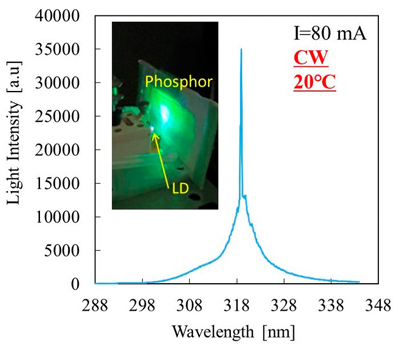
Using this approach, the team demonstrated continuous-wave lasing at a wavelength of 318 nm at 20°C. The laser diode showed a threshold current of 64 mA, corresponding to a threshold current density of 4.3 kA cm-2, and exhibited stable output under continuous electrical injection. Junction-down mounting further improved heat dissipation, enabling sustained operation without performance degradation.
The implications of this advance extend well beyond the laboratory, says the team. In particular, compact UV-B laser diodes could significantly improve medical phototherapy devices used to treat skin disorders and vascular conditions, making them smaller, safer, and more energy-efficient, and easier to deploy in clinical settings.
“Our motivation comes from a long-term vision that began with the invention of the blue LED,” said Dr. Iwaya. “We want to expand the capabilities of nitride semiconductors into the ultraviolet region and develop light technologies that directly contribute to human health and scientific advancement.”
Looking ahead, the ability to fabricate UV-B laser diodes on low-cost, mass-producible sapphire substrates could accelerate their adoption across multiple industries.
Diffraqtion aims high with $10M for 'quantum' camera platform
September 01 2026