 |

08 Jan 2026
To reduce costly, lengthy lab analyses and need for specialists to interpret complex data.
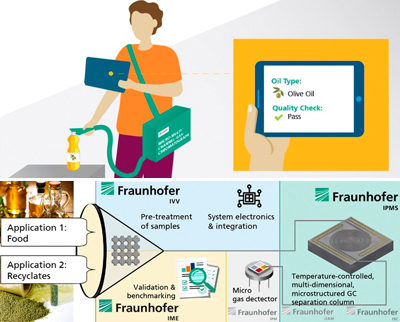
Counterfeit or low-quality products – such as olive oil made from dyed rape-seed oil – are often difficult or impossible to identify at a glance. A mobile gas chromatography sensor system is now being developed to help detect falsely labeled products directly on site. Three Fraunhofer institutes, located across Germany, are working together to create an affordable, easy-to-use device that enables even non-experts to perform rapid, on-the-spot assessments.Food fraud has been on the rise for years. But until now, detecting counterfeit foods has required costly and time-consuming laboratory analyses. In addition, lab-based analysis systems require trained specialists to operate the equipment and interpret the data. Fraunhofer researchers are working to address this issue.
In the Fraunhofer PREPARE project PUMMEL, research teams at the Fraunhofer Institutes for Photonic Microsystems (IPMS), for Molecular Biology and Applied Ecology (IME), and for Process Engineering and Packaging (IVV) are combining their core expertise in gas chromatography measurement methods, sensor development and chemical sensing.
Their goal is to develop a mobile gas chromatography sensor system for rapid on-site detection of volatile organic compounds (VOCs). The detection of VOCs plays an important role in many fields, including food quality and safety.
‘Immediate results’
“There’s a clear need for cost-efficient, rapid and robust on-site measurement technology that yields immediate results,” said Olaf Hild, Head of Department at IPMS. “In the PUMMEL project, we’re focusing on two industrially relevant use cases. First, the identification of counterfeit olive oil, which ranks among the top ten most frequently falsified food products, and second, the detection of contaminated plastic recyclates that can accumulate in packaging materials. For this purpose, we are developing two application-specific demonstrators for VOC detection.”
The mobile system – about the size of a shoulder bag once complete – will consist of a silicon-chip-based gas chromatography column, a detector or sensor, integrated sample preparation, control and data-processing electronics and a power supply.
“Gas chromatography is an analytical method used to separate, identify and quantify mixtures of substances,” said Hild. At the end of the chip-based GC column, a detector measures the substances separated by their molecular characteristics, generating a gas chromatogram with peaks that reveal the composition of the mixture. Fraunhofer IME handles the analysis of the measurement data. In the case of olive oil, the goal is to determine parameters, such as country of origin, age and purity level.
“With our system we’re targeting non-specialists, such as bottlers and incoming-goods inspectors, who can easily operate the device after a short briefing,” said Tilman Sauerwald, a researcher at Fraunhofer IVV, where the demonstrators are currently being developed. “The components of our system can be adapted for specific applications, making it suitable for quality control in a range of different contexts, including the analysis of recycled plastics. We’re more than happy to work with industry partners to develop customized applications.”
The researchers will present some results of the project from March 24 to 27, 2026 at the Analytica trade fair in Munich at the Fraunhofer joint stand in Hall 3, Stand 312.
 |  |  |  |  |  |  |
| © 2026 SPIE Europe |
|