 |

26 Nov 2025
…and Oxford discovers way to switch OLEDs to emit polarized light without altering light-emitters.
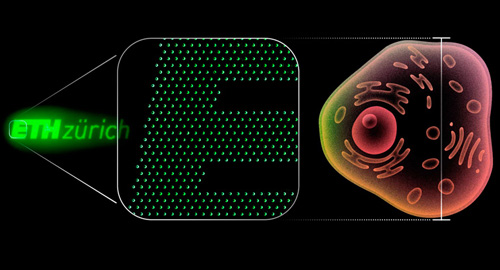
Researchers from ETH Zurich (ETHZ), Switzerland, have manufactured organic light-emitting diodes (OLEDs) at the nanoscale – meaning around one hundred times smaller than a human cell. This not only enables the manufacture of ultra-sharp screens and microscopes, but also opens up entirely novel possibilities for wave optics applications thanks to the extremely minute pixel size.Chemical engineers at ETHZ have succeeded in reducing the size of organic light-emitting diodes (OLEDs), which are primarily in use in premium mobile phones and TV screens, by several orders of magnitude. A description of their achievement was recently published in Nature Photonics.
LEDs are essentially electronic chips made of semiconductor materials that convert electrical current into light. “The diameter of the most minute OLED pixels we have developed to date is in the range of 100 nm, which means they are around 50 times smaller than the current state of the art,” said Jiwoo Oh, a doctoral student active in the nanomaterial engineering research group led by ETH Professor Chih-Jen Shih.
Oh developed the process for manufacturing the new nano-OLEDs together with Tommaso Marcato. “In just one single step, the maximum pixel density is now around 2500 times greater than before,” added Marcato, who is active as a postdoc in Shih’s group.
Screens, microscopes and sensors
On the one hand, pixels ranging in size from 100 to 200 nm form the foundation for ultra-high-resolution screens that could display razor-sharp images in glasses worn close to the eye, for example. To illustrate this, Shih’s researchers displayed the ETH Zurich logo. The logo consists of 2,800 nano-OLEDs and is similar in size to a human cell, with each of its pixels measuring around 200 nm across. The smallest pixels developed so far by the ETH Zurich researchers reach the range of 100 nm across.
These tiny light sources could also help to focus on the sub-micrometer range by way of high-resolution microscopes. “A nano-pixel array as a light source could illuminate the most minute areas of a sample – the individual images could then be assembled on a computer to deliver an extremely detailed image,” said Shih, ETHZ’s professor of technical chemistry. He also perceives nano-pixels as potential tiny sensors that could detect signals from individual nerve cells, for example.
These tiny dimensions also open up possibilities for research and technology that were previously entirely out of reach, as Marcato emphasized. “When two light waves of the same colour converge closer than half their wavelength – the so-called diffraction limit – they no longer oscillate independently of each other, but begin to interact with each other,” he said. In the case of visible light, this limit is between around 200 and 400 nm, depending on the wavelength – and the nano-OLEDs developed by the ETHZ researchers can be positioned this close together.
Conducting initial experiments, Shih’s team was able to use such interactions to manipulate the direction of the emitted light in a targeted manner. Instead of emitting light in all directions above the chip, the OLEDs then only emit light at very specific angles. “In future, it will also be possible to bundle the light from a nano-OLED matrix in one direction and harness it to construct powerful mini lasers,” said Marcato.
Oxford chemists design OLEDs that switch handedness of lightChemistry researchers from the University of Oxford, UK, have for the first time discovered an approach to electrically switch organic LEDs (OLEDs) to emit either left- or right-handed circularly polarized light without changing the light-emitting molecules. They say that this could be useful for a range of technological applications, from more energy efficient OLED displays, to optical information transfer.
The achievement is described in a study published today in Nature Photonics.
Usually, the handedness of such circularly polarized light from LEDs is controlled by choosing a particular mirror image form of the light-emitting molecule within a device. These mirror image forms are referred to as left- or right-handed, or chiral. The handedness of the molecule controls the handedness of the emitted light. This necessarily requires access to both mirror image forms of the molecule, which are complex and expensive to prepare.
Now, the Oxford team have shown that both left- and right-handed forms of circularly polarized light can be produced by just one mirror form of the molecule in an OLED.
The researchers managed to switch the handedness of the emitted light electrically, without changing the material itself. They achieved this by designing emitting materials that show unusual effects on circularly polarized light, together with careful control of the way the electronic charges recombine inside the device.
Controlling light polarization is of particular interest for current and future technologies including low power displays, encrypted communications, and high-performance quantum applications. “Adding circular polarization allows for additional information to be encoded into the light signal,” said Professor Matthew Fuchter, the lead author of the study. “Rather than your signal being simply on or off, it could additionally be on-and-left or on-and-right.”
 |  |  |  |  |  |  |
| © 2026 SPIE Europe |
|