 |

02 Dec 2025
Optical photothermal infrared spectroscopy exploits thermal response of contaminants to illumination.
Microplastic pollution continues to be a significant public health issue, as the materials are increasingly detected in water, soil and elsewhere in the environment.Detecting them within the human body has also become a priority, but doing so without destroying natural tissues presents several challenges.
A pair of research projects involving the Medical University of Vienna (MedUni Vienna) and partners has now developed a new way to locate microplastics within tissue in a non-destructive and spatially resolved manner.
Published in Analytical Chemistry and Scientific Reports (pdf preprint), the findings could advance research and help clarify possible links between microplastic exposure and chronic diseases, noted MedUni Vienna.
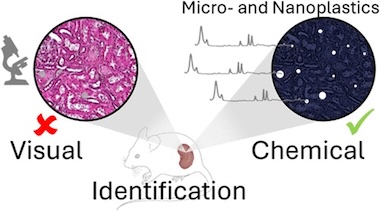
The method is built around optical photothermal infrared spectroscopy (OPTIR), originally developed to visualize chemical structures in complex materials with high spatial resolution. OPTIR involves illuminating a sample with a pulsed IR source, and detecting localized heating of IR absorbing regions with a shorter wavelength visible probe beam.
"OPTIR spectroscopy is characterized by a series of advances compared to conventional mid-IR spectroscopy methods," noted the project in its Scientific Reports paper.
"Among them a significantly improved lateral resolution (~500 nanometers) beyond the classical infrared diffraction limit, the ability to measure in reflection geometry on standard glass sample carriers and the absence of spectral artifacts, which are particularly challenging when small structures are investigated."
As applied to the hunt for microplastics, OPTIR allows the specific signals from materials such as polyethylene (PE), polystyrene (PS) or polyethylene terephthalate (PET) to be detected by the second probe beam, creating an infrared fingerprint that allows unique chemical identification without damaging the tissue.
Linking microplastics with colon inflammation
The new projects mark the first time that OPTIR has been successfully applied to formalin-fixed and paraffin-embedded (FFPE) samples, a type of tissue preparation that is routinely used for examination and archiving of samples in clinical pathology which leaves the tissue structure completely intact.
This means that a chemical analysis can be combined directly with subsequent histological or genetic assessments, allowing microplastics to be both detected and examined in connection with tissue changes.
In trials using colorectal cancer cell lines, mouse tissue models and human tissue samples, the OPTIR method proved capable of imaging individual polystyrene spheres at resolutions of 200 nanometers, surpassing the capabilities of traditional Fourier transform infrared spectroscopy, according to the project's Analytical Chemistry paper.
"We were able to identify various microplastic particles in human colon tissue, including PE, PS and PET," said Lukas Kenner from MedUni Wien. "These were found to be conspicuously frequent in areas with inflammatory changes," suggesting a possible link between microplastics exposure and colon inflammation.
The project has also developed a semiautomated image analysis technique incorporating machine learning algorithms, to accelerate the detection process, improve throughput and minimize the potential for human error.
"The application of OPTIR technology that we have established shows for the first time that both are possible: precise chemical identification and preservation of spatial tissue information," commented Kenner. "A milestone for medical microplastics research."
 |  |  |  |  |  |  |
| © 2025 SPIE Europe |
|