 |

17 Nov 2025
For integrated photonics applications in metrology, frequency conversion, optical computing.
The creation of a compact source of light that fits onto a chip has long been the aim of many photonics labs worldwide. In particular, researchers have wanted to design chips that can convert one wavelength of laser light into multiple other wavelengths — a requirement for building certain quantum computers and for making precision measurements of frequency or time.Now, researchers at the U.S. Joint Quantum Initiative (JQI) have designed and tested new chips that can convert one wavelength of light into a trio of hues. Remarkably, says JQI, the chips all work without any active inputs or painstaking optimization—a major improvement over previous methods.
The team describes their results in the Science.
“One of the major obstacles in using integrated photonics as an on-chip light source is the lack of versatility and reproducibility,” said JQI Fellow Mohammad Hafezi, who is also a Minta Martin professor of electrical and computer engineering and a professor of physics at the University of Maryland. “Our team has taken a significant step toward overcoming these limitations.”
Ordinarily, the interactions between light and a photonic device are linear, which means the light can be bent or absorbed but its frequency will not change (as in a prism). By contrast, nonlinear interactions occur when light is concentrated so intensely that it alters the behavior of the device, which in turn alters the light, potentially generating a panoply of different frequencies.
Generating multiple harmonics
“If you want to simultaneously have second harmonic generation, third harmonic generation, fourth harmonic—it gets harder and harder,” said Mahmoud Jalali Mehrabad, the lead author of the paper and a former postdoctoral researcher at JQI who is now a research scientist at MIT. “You usually compensate, or you sacrifice one of them to get good third harmonic generation but cannot get second harmonic generation, or vice versa.”
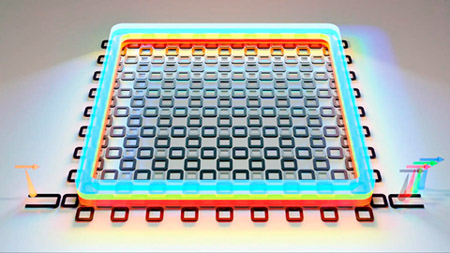
In an effort to avoid some of these tradeoffs, Hafezi and JQI Fellow Kartik Srinivasan, together with Electrical and Computer Engineering Professor Yanne Chembo at the University of Maryland (UMD), have previously pioneered ways of boosting nonlinear effects by using a hoard of tiny resonators that all work in concert. They showed in earlier work how a chip with hundreds of microscopic rings arranged into an array of resonators can amplify nonlinear effects and guide light around its edge.
In 2024, they showed that a chip patterned with such a grid could transmute a pulsed laser into a nested frequency comb—light with many equally spaced frequencies that is used for all kinds of high-precision measurements. However, it took many iterations to design chips with the right shape to generate the precise frequency comb they were after.
In the new work, Mehrabad and colleagues discovered that the array of resonators used in previous work already increases the chances of satisfying the frequency-phase matching conditions in a passive way. Instead of trying to engineer the precise frequencies they wanted to create and iterating the design of the chip in hopes of getting one that worked, they stepped back and considered whether the array of resonators produced any stable nonlinear effects across all the chips. They found that their chips would generate second, third and even fourth harmonics for incoming light with a frequency of about 190 THz.
They realized that the reason all their chips worked was related to the structure of their resonator array. Light circulated quickly around the small rings in the array, which set a fast timescale. But there was also a “super-ring” formed by all the smaller rings, and light circulated around it more slowly. Having these two timescales in the chip had an important effect on the frequency-phase matching conditions.
The researchers tested six different chips manufactured on the same wafer by sending in laser light with the standard 190 THz frequency, imaging a chip from above and analyzing the frequencies leaving an output port. They found that each chip was indeed generating the second, third and fourth harmonics, which for their input laser happened to be red, green and blue light. They also tested three single-ring devices.
Even with the inclusion of embedded heaters to provide active compensation, they only saw second harmonic generation from one device over a narrow range of heater temperature and input frequency. By contrast, the two-timescale resonator arrays had no active compensation and worked over a relatively broad range of input frequencies. The researchers showed that as they dialed up the intensity of their input light, the chips started to produce more frequencies around each of the harmonics.
The authors say that their framework could have broad implications for areas in which integrated photonics are already being used, especially in metrology, frequency conversion and nonlinear optical computing. “We have simultaneously relaxed these alignment issues to a huge degree, and also in a passive way,” said Mehrabad. “We don’t need heaters. They just work. It addresses a long-standing problem.”
 |  |  |  |  |  |  |
| © 2026 SPIE Europe |
|