


Danish group’s nanolaser could halve computer energy use
A step towards future digital communications by all-optical microchips.
16 February 2026
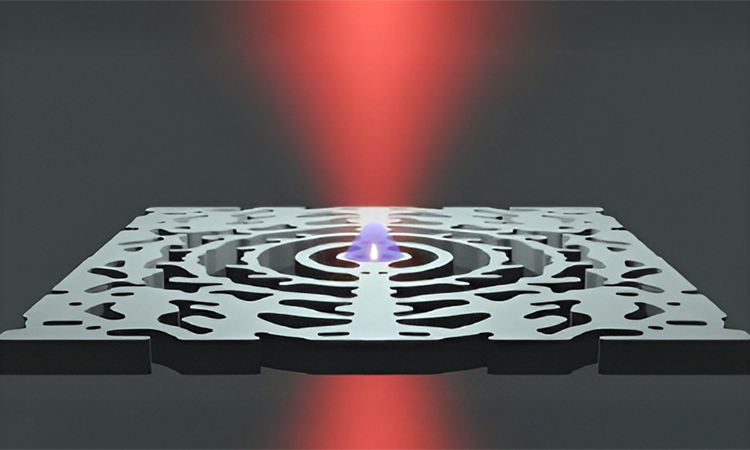
DTU researchers have invented a nanolaser constructed in a semiconductor membrane that causes electrons and light to gather in a small area (blue shadow). By using light instead of electrical signals on microchips, data speed can be increased and energy loss reduced. The schematic of the nanolaser based on extreme dielectric confinement, shows an extreme dielectric confinement (EDC) laser under optical pumping with a focused Gaussian beam (red light), generating a region (blue shading) where excited carriers are concentrated and leading to enhanced spatial overlap with the optical cavity field (bright dot). Illustration: Yi Yu / DTU.
Researchers at the Technical University of Denmark (DTU) have developed a new type of nanolaser, which they say could be the key to much faster and much more energy-efficient computers, phones, and data centers. The invention of the nanolaser is described in Science Advances.
The Science Advances paper describes the fabrication and structure of the nanolaser thus: “The device is fabricated within a 250-nm-thick indium phosphide (InP) membrane embedded with three InGaAsP QW layers. First, the InP wafer is flip bonded to a Si/SiO2 substrate. The laser membrane is formed after removing the InP substrate and an InGaAs etch-stop layer.”
Electron beam lithography
The paper continues, “A SiNx layer is deposited onto the wafer, followed by the spin coating of a photoresist. The structures are then patterned using electron beam lithography. This pattern is transferred to the SiNx hard mask and subsequently to the InP layer through a two-step semiconductor etching.
“Following the etching, the sample undergoes a passivation process, where it is first treated in a solution of ammonium hydroxide to remove the oxide layer and then annealed inside the MOVPE reactor to repair and seal the QWs. After the annealing, the structures are membranized and encapsulated with an Al2O3 layer via atomic layer deposition.”
The technology offers the prospect of thousands of the new lasers being placed on a single microchip, thus opening a digital future where data is no longer transmitted using electrical signals, but using light particles, photons.
“The nanolaser opens up the possibility of creating a new generation of components that combine high performance with minimal size. This could be in information technology, for example, where ultra-small and energy-efficient lasers can reduce energy consumption in computers, or in the development of sensors for the healthcare sector, where the nanolaser’s extreme light concentration can deliver high-resolution images and ultrasensitive biosensors,” said DTU professor Jesper Mørk, who co-authored the publication together with, among others, Drs. Meng Xiong and Yi Yu from DTU Electro.
‘Halving energy use’
The DTU announcement states that “by bringing light directly into the microchip itself using nanolasers, the digital technology of the future can become faster, cooler, and far more climate friendly”. This is possible because nanolasers can efficiently generate light signals that can be transmitted with almost no energy loss. When it comes to computers, Mørk estimates that nanolasers can halve energy consumption.
The nanolaser was developed in DTU’s clean room, DTU Nanolab, and, according to Mørk, it “breaks the traditional limit on how small lasers can be”. The laser is based on a light-trapping structure – a nanocavity – that concentrates light extremely powerfully in an area so small that such designs were previously considered impossible.
When the researchers illuminate the laser with a beam of light, both the light and the electrons gather in a microscopic area. This enables the laser to operate at room temperature with unusually low energy consumption. The DTU researchers’ light-trapping structure was originally designed by Prof. Ole Sigmund’s group from DTU Construct.
If the nanolaser can be powered electrically in the future—and that will be the next big challenge in research – it could revolutionize a wide range of technologies, says the DTU group. Computers and smartphones could use significantly less power and deliver higher performance, and data centers could dramatically reduce their energy consumption, resulting in major climate savings.
Within health technology, the nanolaser would enable the development of ultra-sensitive sensors and high-resolution imaging systems. Researchers estimate that the final technical challenges can be solved within the next five-to-ten years.
Quantum imaging research promises improved retinal scans
October 20 2025
Diffraqtion aims high with $10M for 'quantum' camera platform
September 01 2026