


Quantum imaging research promises improved retinal scans
EU-funded project testing novel approach to reveal finer detail in the eye than before.
20 October 2025 Research & Development
 A European research consortium is exploring a new quantum imaging technique that could one day help clinicians see the earliest signs of eye disease.
Developed under the €4.5 million Horizon Europe-funded SEQUOIA project, the technique combines quantum physics and artificial intelligence to "push beyond the limits of optical coherence tomography"(OCT), according to the European research group.
Although widely used to diagnose eye diseases such as macular degeneration, glaucoma, and diabetic retinopathy, conventional OCT systems often struggle to resolve details smaller than 1 μm.
This 1 μm limitation matters because some of the earliest signs of disease begin with subtle changes in the retina's structure at these tiny scales. If such changes cannot be seen clearly, diagnosis may come too late to prevent lasting damage.
To address this limitation, the SEQUOIA team is testing a new approach that uses quantum-entangled photons and advanced AI control to probe tissue structure at much finer scales, potentially reaching resolutions down to 0.5 μm.
A resolution of 0.5 μm would be twice as sharp as most current OCT systems and could prove crucial in the fight against preventable blindness. Many eye diseases begin with subtle structural changes at the cellular level, such as swelling, thinning, or disruptions in the delicate layers of the retina.
Quantum approach
By enabling researchers to visualise the retina in much finer detail, this new quantum approach could allow clinicians to detect disease earlier, make more confident diagnoses, and begin treatment before vision is permanently affected. Improved resolution also brings sharper image edges, helping distinguish between healthy and damaged tissue - a vital step in reducing diagnostic uncertainty and improving patient outcomes.
The project hopes to lay the groundwork for future imaging systems capable of revealing earlier signs of disease. "Our aim is to investigate whether quantum OCT can provide clinicians with information at smaller scales than today's systems," said Dr Patrick Bowen Montague, coordinator of SEQUOIA. "At this stage, it's a feasibility study; we are testing the potential, not a finished product.".
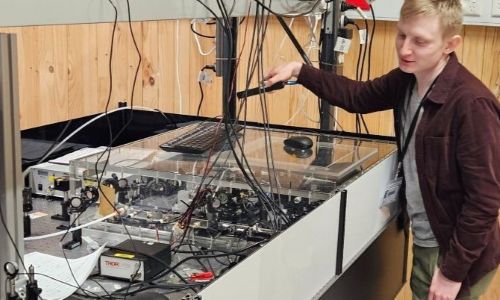
The SEQUOIA team is studying the use of entangled photons - pairs of quantum-linked light photons - to illuminate the retina. These photon pairs may allow imaging of sub-micron structures that classical light sources miss.
Current prototypes, however, work with single photons and therefore scan much more slowly than conventional OCT. The project's research includes exploring a Fourier domain detection method, which could improve efficiency by removing moving parts, but the technology remains at an early experimental stage.
Teams in Spain and Germany are also investigating how machine learning can be used to shape the quantum light itself. By imprinting orbital angular momentum, they hope to sharpen edges and reduce interference.
The quantum light is generated using one of the world's most stable broadband sources, developed by NKT Photonics in collaboration with the German National Metrology Institute (PTB).
Impact assesment
SEQUOIA is also pioneering a new social impact assessment framework for medical devices, described as "a first for quantum health technology". Using a structured "deck of cards" method, experts from ophthalmology, AI, and imaging manufacturing are ranking key criteria such as diagnostic accuracy, speed, sustainability, and patient benefit. They say that this approach will help ensure that if quantum OCT does become viable, it addresses real clinical needs and practical considerations.
Although still in the feasibility phase, the SEQUOIA consortium is already considering the long-term path to market, including the cost of photon sources, detectors, and high-performance computing. By planning early, the project hopes to lay the groundwork for a clinic-ready, affordable system if the research proves successful.
The SEQUOIA project brings together institutions from across Europe, each contributing key expertise to this ambitious research effort. Nicolaus Copernicus University (Poland) leads the consortium, with NKT Photonics (Denmark) and PTB (Germany) developing the ultra-stable light sources that underpin the imaging system.
Leading experimental validation is DTU (Denmark), while UPV and ICFO (Spain) are working on advances in machine learning and photonics. ARDITEC (Italy) supports the project's pioneering social impact assessment. Together, the partners are laying the foundations for a potential leap forward in quantum medical imaging.
Diffraqtion aims high with $10M for 'quantum' camera platform
September 01 2026