


UIUC observes plants breathing in real time
Confocal laser microscopy helps quantify processes underway at stomata.
07 January 2026
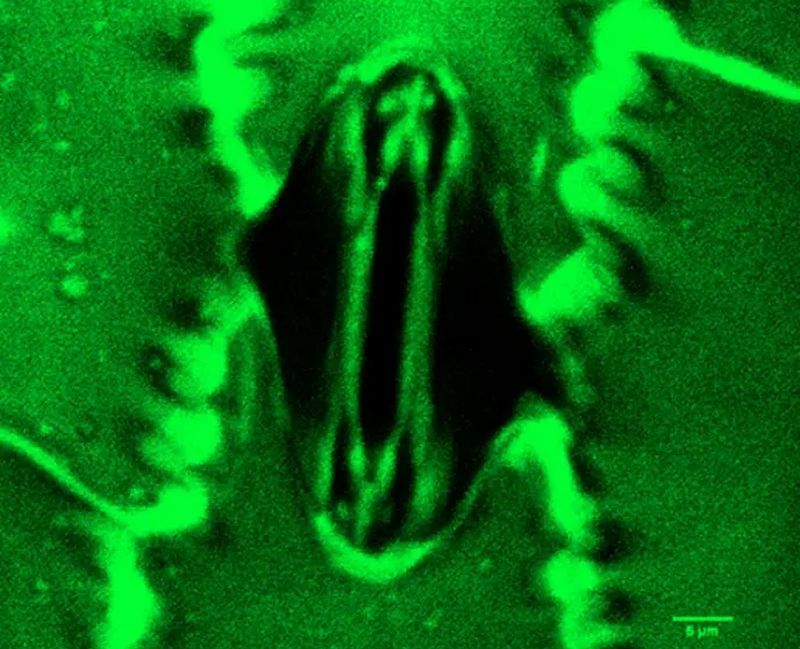
Details of the process in which plants transfer gases through the pores on their leaves called stomata remain hard to study.
The anatomy of stomata can be seen through optical microscopy, but difficulties in controlling the atmospheric environment of a microscope stage make it tricky to recreate in a lab the scenarios in which gas transfer occurs.
Stomata also respond quickly to changes in light, temperature, humidity and carbon dioxide levels, confusing the experimental data.
A project at the University of Illinois Urbana-Champaign (UIUC) has now tackled this long-standing challenge in plant biology, and developed an experimental platform able to watch and quantify these processes in real-time.
The study, published in Plant Physiology, should lead to new insights on how stomatal anatomy and function are balanced to influence the "breathing" of plants, with eventual implications for agriculture and food supply.
UIUC's platform, christened Stomata In-Sight, combines laser scanning confocal microscopy, gas exchange instruments and machine-learning image analysis, to simultaneously observe anatomical characteristics of many stomata alongside leaf-level traits like photosynthesis, transpiration, and stomatal conductance.
Stomata In-Sight was designed around a modified leaf gas exchange system, into which the researchers then integrated a commercial Zeiss laser scanning confocal microscope.
"Integration of a confocal microscope with a leaf gas exchange system is significant," noted the UIUC team in its paper. "It has the potential to explore long-standing unknowns about stomatal structure-function relationships in eco-physiology and stomatal behavior, which can aid efforts for improved water-use efficiency in agriculture."
Predicting real-world agriculture behavior
Since confocal microscopy blocks out-of-focus light from detection, the platform's high-intensity illumination could remain on throughout the measurement procedure. This combined with a suitable microscope objective allows Stomata In-Sight to measure the area of open stomatal pores with a resolution of 0.25 square-microns per pixel.
"This was critical since stomatal apertures in grasses are often narrow rectangular shapes, where opening involves increases in width of just a few microns that are then multiplied across a length that may be an order of magnitude greater in scale," commented UIUC.
In trials using maize plants and varying combinations of light and carbon dioxide partial pressures, the project was able to assess spatial variations in stomatal aperture and density across a leaf surface in new detail, and study how these variables of plant physiology affected the gas transfer as it took place.
A machine learning image analysis model was developed to detect and measure pore lengths and widths from the optical data, so that the throughput of the analysis procedure could be increased significantly compared to analogue assessments.
This model was successfully able to predict gas conductance from the image data and the measured environmental conditions, reconciling the microscopic stomatal characteristics with leaf-level gas exchange and modelling their relationship in real-world scenarios.
"Traditionally, we've had to choose between seeing the stomata or measuring their function," said UIUC. "This technical advancement will provide insight on how stomatal anatomy and function trade off to influence leaf-level water use efficiency."
UIUC sensor spots signs of cancer cells
November 07 2023
Leica and Cognex launch AI software module Aivaro to improve inspection
September 30 2026
Photonic monitoring to identify food safety, quality, and animal welfare
September 30 2026
Advances in optics and computation boost coronary intravascular imaging
September 30 2026
Australia’s SKA tests antenna layout for Low telescope
September 30 2026
Artemis merges Optikos with Omega Optical
September 30 2026