


Raman spectroscopy reveals details of fragile archeological ivory
Chinese Academy of Sciences allows chemical analysis even when fluorescence would normally interfere.
06 January 2026
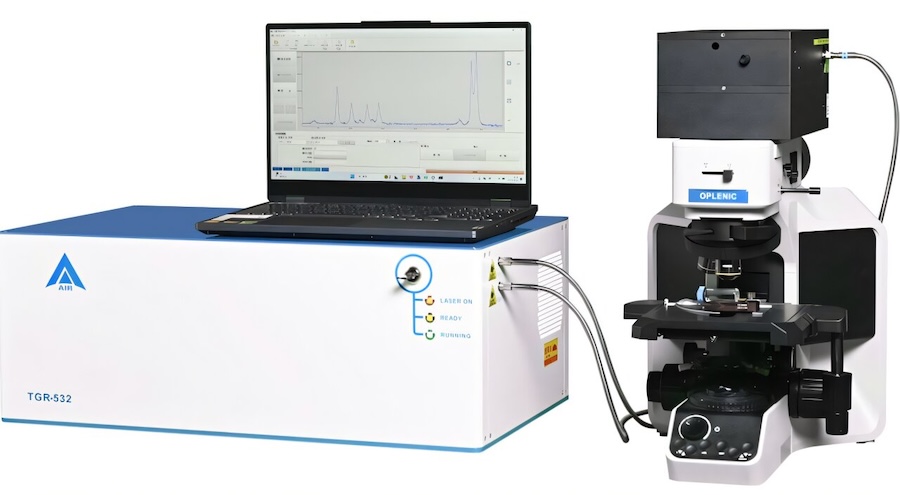
A project at the Aerospace Information Research Institute of the Chinese Academy of Sciences (AIRCAS) has used a Raman technique to study samples of fragile archeological ivory.
Discussed in ACS Applied Materials & Interfaces, the Raman approach could point to new non-destructive, high-resolution analytical tools for conservation and restoration efforts.
In particular the technique could avoid the common inherent problem of strong natural fluorescence from the samples under analysis, which would normally obscure other spectroscopic signals of interest.
Ivory artifacts excavated from the Sanxingdui Ruins in Sichuan, dating back more than 3,000 years, are invaluable for understanding China's ancient Shu civilization. However, prolonged burial conditions, including groundwater, soluble salts, and microbial activity, can severely weaken ivory internally while leaving the exterior seemingly intact, said AIRCAS.
Raman spectroscopy should be ideal for revealing the molecular composition of these delicate samples, but archaeological materials often produce strong fluorescence under laser illumination, overwhelming the much weaker Raman signals and rendering conventional measurements ineffective.
The AIRCAS solution was to develop a time-gated Raman approach, separating Raman scattering signals from fluorescence based on their fundamentally different time scales. Raman signals occur instantaneously after laser excitation, whereas fluorescence persists far longer.
By precisely synchronizing an ultrashort detection window with the Raman signal, the instrument effectively suppresses background fluorescence and retrieves Raman spectra from strongly fluorescent materials.
Time-gated Raman reveals burial microenvironments
"In this study, 532 nanometer time-gated Raman spectroscopy overcame these limitations, enabling high spatial resolution and effective fluorescence suppression for detailed compositional analysis," noted the project in its ACS paper.
To test the new approach, AIRCAS examined four ivory fragments excavated from Bronze Age sacrificial pits at a site in Sanxingdui. Under conventional continuous-wave Raman conditions, two of the samples yielded little to no usable spectral information due to fluorescence.
Time-gated Raman measurements, however, effectively suppressed fluorescence interference and improved the signal-to-noise ratio by more than 20 times in strongly fluorescent samples, revealing clear internal compositional differences according to the project.
Analysis of the data indicated that ivories from different burial environments exhibit pronounced differences in organic content, mineral crystallinity and corrosion severity.
The results also suggest that metal-ion infiltration and non-metal ion substitution, such as sulfate replacing structural components in hydroxyapatite, play a central role in the deep degradation of ivory. In some specimens, spectral features consistent with possible heat exposure were also observed, pointing to potential fire-related damage.
"These results demonstrate the strength of time-gated Raman spectroscopy for nondestructive, spatially resolved analysis of ancient ivory and reveal degradation pathways shaped by burial microenvironments," said the project. "It offers essential insights for the scientific conservation of archeological ivory."
High-res laser scan reveals Stonehenge secrets
October 09 2012
Diffraqtion aims high with $10M for 'quantum' camera platform
September 01 2026