


UC Davis shrinks spectrometer for diagnostics and sensing
Surface-enhanced silicon photodiodes and AI combine to extend device's sensitivity, utility.
28 January 2026
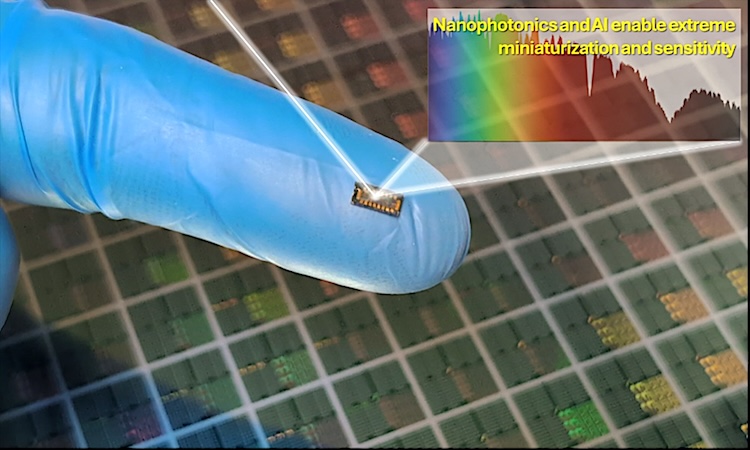
A project at the University of California, Davis (UC Davis) has developed a compact spectrometer-on-a-chip that could enhance hyperspectral sensing operations.
As described in Advanced Photonics the research "aimed to shrink a lab-grade spectrometer down to the size of a grain of sand, a tiny spectrometer-on-a-chip that can be integrated into portable devices."
"We wanted to take the power of a spectrometer out of the lab and put it in your pocket," commented Ahasan Ahamed of UC Davis.
Ways to miniaturize infrared sensing devices have been the focus of varied research efforts, frequently making use of modified photodetectors with novel properties.
Previous examples include the project at Switzerland's Empa lab to incorporate colloidal quantum dots into sensors for both consumer electronics and specialized space devices.
The UC Davis device exploits the properties of photon-trapping surface textures (PTST), surface modifications that enhance the light absorption capabilities of silicon photodiodes in the near-IR range by coupling the incident light into guided modes that effectively increase the path length.
"The enhanced light absorption capabilities of PTST improve the efficiency and sensitivity of the photodiodes, which in turn boost the efficacy of the spectrometer-on-a-chip at NIR wavelengths," noted the project in its paper.
This new chip employed 16 distinct silicon detectors, with PTST boosting the efficacy of the spectrometer at those near-IR wavelengths where absorption is typically low. A neural network then took over, computationally reconstructing the spectral information from the measured photocurrents.
Integrating deep learning into the operation represents a key step toward AI-augmented spectral sensing, commented UC Davis, with neural networks enabling compact hardware to achieve high spectral fidelity, something traditionally possible only with bulky systems.
Truly integrated real-time hyperspectral sensing
In proof-of-concept trials the UC Davis team manufactured a sensor with a 0.4 mm2 footprint, and tested its performance in hyperspectral imaging as a model of possible real-world capabilities. The results demonstrated a high degree of accuracy and fidelity, said the team, with the use of AI-augmented spectral reconstruction enabling the system to extract accurate hyperspectral data even with limited hardware.
The device also maintained signal clarity even in the presence of significant electrical interference, outperforming conventional spectrometers. Since this can be a major challenge in portable, low-cost electronics, the new approach could be advantageous in several potential applications.
By extending the sensing range of silicon into the near-IR and enabling high performance through machine learning, this technology establishes a pathway for truly integrated, real-time hyperspectral sensing across applications ranging from advanced medical diagnostics to environmental remote sensing, said the project.
"We are paving the way for a future where your watch or phone doesn’t just take pictures, but analyzes the chemistry of the world around you," said project leader Saif Islam of UC Davis.
Empa miniaturizes infrared detectors with quantum dots
October 27 2022
UC Davis miniscope improves imaging of neural activity
September 15 2025
Diffraqtion aims high with $10M for 'quantum' camera platform
September 01 2026