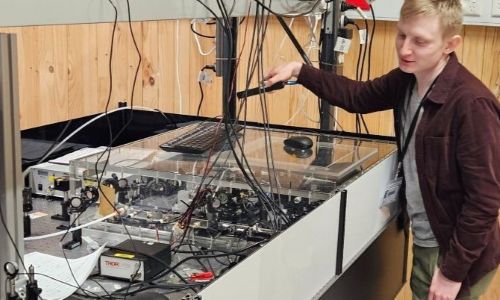



UC Davis miniscope improves imaging of neural activity
Miniaturized microscope plus AI processing could lead to new therapies for brain disorders.
15 September 2025 Research & Development
 Miniaturized fluorescence microscopes are a key element in the development of endoscopes and implantable devices, but developers face inherent trade-offs relating to footprint, field of view and resolution.
One design element in many miniscopes is a thin optical phase mask in place of bulk optics, encoding the 3D fluorescence intensity from a sample into a single 2D measurement, although this approach can still struggle when dealing with dense fluorescence samples.
A project at the University of California, Davis (UC Davis) has now developed a novel microscope platform called DeepInMiniscope, pairing an integrated microscope architecture with a custom designed optical mask and a physics-informed computational algorithm.
The team's goal was to manufacture a device small and ergonomic enough for a mouse to comfortably and safely wear the corded miniscope as the animal moves freely, giving new information about the activity of the brain.
Described in Science Advances the new device "holds great promise for scalable, large field-of-view, high-speed 3D imaging applications with compact device footprint."
The UC Davis lab of Weijian Yang has made a number of previous breakthroughs in miniaturized optical platforms, including a lensless camera designed to capture 3D information from a scene in a single exposure, and a two-photon microscope intended specifically for rapid brain imaging at high resolution.
DeepInMiniscope builds on this earlier work through the use of a new optical mask design containing more than 100 miniaturized high-resolution lenslets. A novel neural network designed to require only a minimal amount of training data then combines images from each lenslet to reconstruct images in 3D.
Understanding brain disorders and development
"What we are doing is creating technology to image brain activity in freely moving and behaving mice to open up the behavior paradigm," said Weijian Yang. "The goal is to create a device capable of enabling research into brain activity and behavior in mice in real time; to see how brain activity drives behavior or perception."
In trials imaging the visual cortex of an awake mouse, DeepInMiniscope and its associated algorithm were able to reconstruct object volumes over 4 x 6 x 0.6 millimeters.
This is a "substantial improvement in both reconstruction quality and speed compared to traditional methods for large-scale data," commented UC Davis. "We imaged neuronal activity with near-cellular resolution in awake mouse cortex, representing a substantial leap over existing integrated microscopes."
The next steps will include employing microlens units with different NAs and focal lengths, and increasing the imaging acquisition speed with different fluorophores or parallel computation.
"This technology not only advances our fundamental understanding of how the brain processes information and drives behavior, but also contributes to improving our understanding of brain disorders and the development of future therapeutic strategies in humans," commented Yang.
Diffraqtion aims high with $10M for 'quantum' camera platform
September 01 2026