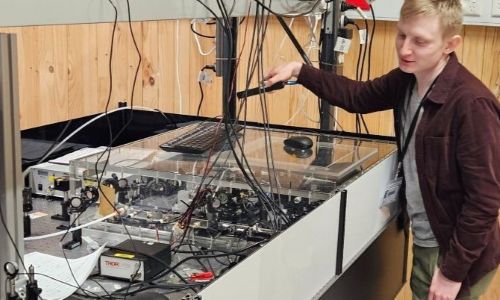



University of Colorado Boulder enhances OCT for eye and heart examination
Electrowetting beam-steering prism allows smaller devices without sacrificing performance.
20 August 2025 Photonics Applications News
 Optical coherence tomography is well established in ophthalmology clinics as a route to cross-sectional images of the retina.
The same technology is valuable in the cardiac health sector, where intravascular OCT imaging platforms have been created to help surgeons make personalized decisions during heart surgery and stent placement.
These applications benefit from miniaturized OCT devices, in particular to let imagers fit within endoscopic devices and meet constraints on device performance and power consumption. But this is a hurdle for applying the technique in new applications or enhancing existing ones.
MEMS scanners based on electrostatic and electrothermal actuation have been employed in endoscope-scale OCT platforms to reduce the size of the device and allow a forward-viewing endoscope, although they in turn force a compromise between scanning speed and drive voltage.
A project at the University of Colorado Boulder (CU Boulder) has now demonstrated an OCT architecture in which an electrowetting beam-steering prism carries out the platform's lateral scanning operation, a non-mechanical approach that reduces the power requirements and complexity.
Described in Optics Express, the new architecture could lead to improved detection of eye and heart conditions.
"The benefit of non-mechanical scanning is that you eliminate the need to physically move objects in your device, which reduces any sources of mechanical failure and increases the overall longevity of the device itself," said CU Boulder's Samuel Gilinsky.
Critical technique for imaging inside bodies
The team tested its device on zebrafish, animals whose eyes are known to be similar in structure to those of humans, and assessed whether the modified OCT imager could identify the eye's cornea, iris and retina tissues at 10 microns axial and 5 microns lateral resolution.
"The interesting result was that we were able to actually delineate the cornea and iris in our images," said Gilinsky. "We were able to meet the resolution targets we aimed for, which was exciting."
This may open new doors for mapping aspects of the retina essential for diagnosing potential eye conditions like age-related macular degeneration and glaucoma, but CU Boulder also envisages electrowetting-based scanners being of benefit for forward-facing endoscopes used in other applications, such as the imaging of coronary disease.
"There is a growing push to make endoscopes as small in diameter and flexible as possible to cause as little discomfort as possible," commented Gilinsky.
"By using our components, we can maintain a very small scale optical system compared to a mechanical scanner that can help OCT technologies. This could be a critical technique for in-vivo imaging inside our bodies."
Diffraqtion aims high with $10M for 'quantum' camera platform
September 01 2026