 |

17 Dec 2025
Elliptical retarder model improves polarization analysis for material design and biomedical imaging.
Scientists at the University of Oxford, UK, have demonstrated a novel approach to interpreting how materials interact with polarized light, which they say could help advance biomedical imaging and material design.The work, reported in Advanced Photonics Nexus, focuses on improving how researchers analyze a key optical property known as the retarder.
In optics, a retarder is a material or device that changes the way light waves are oriented as they pass through. Light waves have an orientation called polarization, and a retarder shifts the phase between different components of that light—essentially delaying one part of the wave compared to another.
Revealing hidden details of a structure
This property is widely used in technologies like LCD screens, microscopes, and imaging systems because it can reveal hidden details about a material’s structure.
For decades, scientists have relied on Mueller matrix polarimetry, a technique that uses a 16-element matrix to describe how a sample alters light’s polarization. A key part of this matrix is the retarder component.
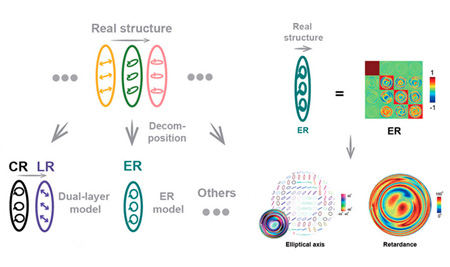
Traditionally, researchers assume that a retarder’s behavior can be broken down into two simple types: a linear retarder, which delays light along one axis, and a circular retarder, which rotates the direction of linear polarization. But real materials often have complex or unknown internal structures, making this assumption unreliable.
To overcome this limitation, Runchen Zhang and colleagues, led by Professor Chao He at Oxford, proposed to use a more general approach—treating any retarder with the elliptical retarder model.
By this approach, the retarder is described by three parameters—elliptical axis orientation, degree of ellipticity, and elliptical retardance—rather than being forced into a layered model. This set of parameters, originally proposed by Lu and Chipman but less commonly used, captures the full retarder properties without requiring prior knowledge of the material’s structure.
Tests on liquid crystal samples showed that the elliptical model avoids misinterpretations common with conventional methods. For example, it correctly characterized samples with layered structures and even droplets with no distinct layers.
This approach simplifies the interpretation of polarization data for retarders with unknown or intricate structures. It could improve biomedical imaging, where bulk tissue often contains multiple layers with varying properties, and enhance the design of structured-light modulation devices such as cascaded waveplates or spatial light modulators. The authors note that further refinements are needed to address phase ambiguities, but the model offers an alternative perspective for more versatile polarization analysis.
• This article was first published on spie.org.
 |  |  |  |  |  |  |
| © 2025 SPIE Europe |
|