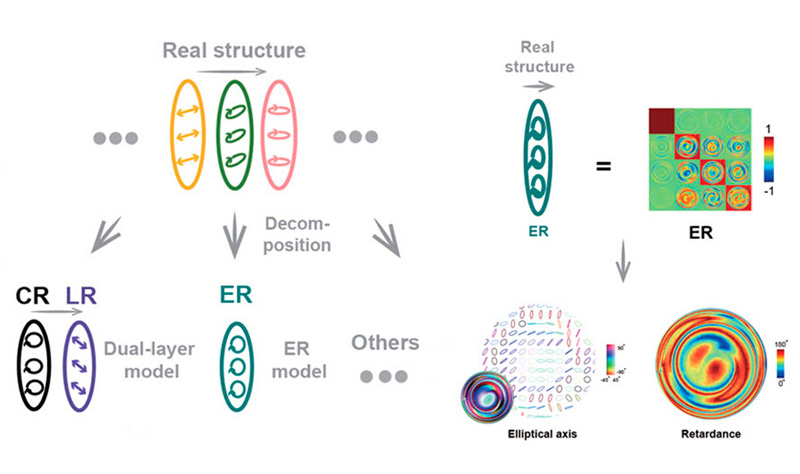
| In polarization analysis, the real structure of a retarder sample may consist of multiple layers or a continuous, nonlayered structure (left). Conventional approaches typically model the sample as a circular retarder (CR) followed by a linear retarder (LR), which may lead to misinterpretations. A method that employs an elliptical retarder (ER) model avoids this issue by characterizing the overall properties of any retarder without requiring prior knowledge of its internal structure. On the right, an example of a liquid-crystal droplet, which has a continuous, nonlayered structure. Its ER decomposition demonstrates the spatial distributions of the elliptical fast axis and retardance. Image credit: R. Zhang et al., University of Oxford / Advanced Photonics Nexus, SPIE. |