 |

17 Mar 2026
Light-scattering data give insights into milk composition.
A project at the University of Twente has carried out two investigations into the optical properties of human milk.Published in Biophotonics Discovery, the studies aimed to develop objective and noninvasive methods of measuring milk composition.
Many mothers struggle with initiating and maintaining breastfeeding, noted the Twente project, and 40 to 60 percent of mothers may stop breastfeeding due to a perception of low milk supply.
Increasing evidence shows that this may not be just a perception, with an estimated incidence of actual lactation insufficiency of 10 to 15 percent. The underlying causes of this insufficiency are currently poorly understood, however.
The light scattering behavior of milk contains a wealth of information about the milk composition, in particular fat content. Fat forms the main source of energy in milk, and changes in fat concentration are predictive for adequate milk production after birth.
In the first Biophotonics Discovery study, Twente collaborated with the University of Amsterdam to investigate the refractive indices of the light scattering particles in human milk, the first study of its kind. Knowing the refractive index of the milk fat globules (MFGs) and extracellular vesicles (EVs) in the fluid is essential for accurate interpretation of any further data obtained by optical methods, such as laser diffraction analysis.
The team used flow cytometry to assess the refractive index distribution of the two components in human milk, and confirm that they were qualitatively different from that of the same components in cow's milk, sometimes used as a baseline in analysis.
"The refractive index distribution of human MFGs has a significantly higher mode than the refractive index distribution of bovine MFGs, which is in line with the differences in fatty acid composition between the two species," wrote the project. "The use of bovine instead of human MFG refractive index values in laser diffractometry can lead to significant errors."
In-depth research into lactation insufficiency
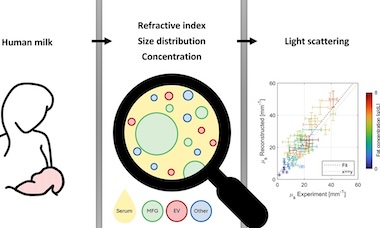
The second Twente study used the measured refractive indices from the first study to model the light scattering behavior of human milk, and predict the effects of other sample-specific properties such as fat concentration, milk serum refractive index and milk particle sizes on the forward scattering coefficient of human milk samples.
It found that the light scattering behavior of human milk is not only influenced by its fat concentration, but also by the sample-specific size distribution of the fat particles in the milk.
Taken together as part of Twente's studies of human milk and lactation, the new data point towards improved light scattering-based methods for human milk analysis, a valuable route to compact and fast analysis techniques that also preserve the milk for infant consumption afterwards.
Inline monitoring of changes in milk composition during a single breastfeed with such techniques "would provide a powerful tool for more in-depth research into lactation insufficiency," noted the project.
"The established dataset of human milk optical properties can be expanded and utilized in future studies to support the development of optics-based measurement systems and further research on breastfeeding, using non-invasive methods."
 |  |  |  |  |  |  |
| © 2026 SPIE Europe |
|