 |

12 Mar 2026
UMC and Wavetek sign a strategic manufacturing partnership in bid to commercialize TFLN photonics.
HyperLight, the Harvard University spin-out specializing in thin-film lithium niobate (TFLN) photonics, has agreed a manufacturing deal with foundry partners in Taiwan as it looks to scale to volume production.
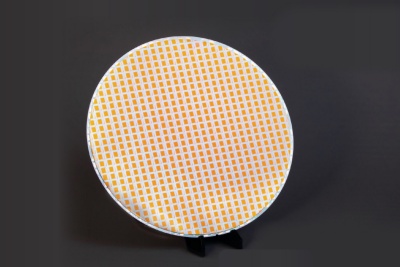
The startup will work with United Microelectronics Corporation (UMC) and its compound semiconductor focused subsidiary Wavetek to fabricate its “Chiplet” platform on both 6-inch and 8-inch diameter wafers.
Chiplet is said to uniquely combine the superior optical characteristics of TFLN - such as high electro‑optic efficiency, low optical losses, a wide transparency window, optical nonlinearities, and compatibility with microelectronic systems - with scalable CMOS-like fabrication techniques.
“The [UMC/Wavetek] collaboration marks a major inflection point in the commercialization of TFLN photonics, enabling the manufacturing capacity required for AI and cloud infrastructure deployment at scale,” announced HyperLight.
The startup adds that its innovative approach will deliver unprecedented bandwidth and energy efficiency for optical communications and AI data centers, as well as emerging applications such as quantum computing.
Designed to enable AI-infrastructure-scale production, the Chiplet platform is claimed to unify the requirements of short-reach data center pluggables with longer-reach coherent-based datacom and telecom modules, and co-packaged optics (CPO) within a single high-volume manufacturable architecture.
TFLN ‘niche era’ is over
While the advantages of TFLN have long been understood, HyperLight is looking to UMC and Wavetek to provide the high-volume foundry manufacturing infrastructure that has so far been lacking.
The startup has already worked with Wavetek to bring the technology from laboratory scale to a customer-qualified, high-volume manufacturing (HVM) line within a 6-inch CMOS foundry, and UMC will now add its 8-inch production capability to meet the kind of scale demanded by AI infrastructure.
HyperLight CEO Mian Zhang said: “TFLN has long been recognized as one of the most important technologies for the future of optical interconnects, but the industry has been waiting for a path to true manufacturing scale.
“The HyperLight TFLN Chiplet Platform was architected from the beginning to unify the requirements of IMDD [intensity modulation direct detection], coherent, and CPO into a single manufacturable foundation. The era of TFLN as a niche technology is over.
“Together with UMC and Wavetek, we are bringing TFLN into high-volume foundry production - enabling the performance, reliability, and cost structure required for AI infrastructure deployment at global scale.”
UMC senior VP G C Hung added: “To achieve 1.6T bandwidth and beyond, TFLN is emerging as a promising material to deliver the bandwidth requirements for next-generation data center connectivity.
“UMC is pleased to be a key 8-inch manufacturing partner to bring HyperLight’s scalable platform to the mass market. This partnership sets a new benchmark in the industry and positions the team to lead TFLN production for the rapid growth of AI, cloud, and networking infrastructure.”
 |  |  |  |  |  |  |
| © 2026 SPIE Europe |
|