 |

09 Dec 2025
Miniaturized MiniVolt device catches voltage spikes in live animals for better view of brain activity.
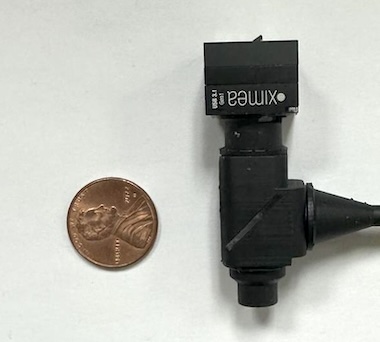
A project at the University of Colorado Boulder (CU Boulder) has developed a new way to image neural activity in live animals.Described in Biomedical Optics Express, the device is a miniaturized microscope that could offer a more complete view of how brain cells process information.
CU Boulder's goal was to find a better way of carrying out in vivo voltage imaging, in which genetically encoded fluorescent markers change brightness when a neuron fires thanks to voltage changes across neuron membranes.
This principle should allow researchers to measure precisely the rates at which neurons fire and see the synchronized activity that takes place. But the optical platforms involved have remained unsuitably bulky for use on live animal subjects.
"Challenges with extending voltage imaging to miniature microscopes arise from stringent size and weight requirements for freely moving animal studies, coupled with demanding sensor specifications and collection efficiency," noted the team in its published paper.
The team's MiniVolt device was designed to tackle these hurdles, with numerical aperture and image sensor quantum efficiency optimized to suit the particular requirements of the in vivo voltage imaging operation.
To boost the amount of light collected, the researchers custom-designed an optical system that achieves a numerical aperture of 0.6 in a small format. They also incorporated a compact, high-efficiency camera that can acquire images at approximately 500 frames per second, fast enough to capture the millisecond timescale of action potentials.
New treatments for neurological disorders
"We took a big step toward tackling these constraints by designing a compact, efficient optical system with high numerical aperture and pairing it with a high-speed sensor to reliably detect action potential spiking," commented Juliet Gopinath from CU Boulder.
"Our microscope enables recording of both the rapid electrical spikes and the smaller sub-threshold voltage changes that occur inside neurons in freely moving animals."
The final MiniVolt design has a 250-micron field of view, a 1.3 to 1.6 millimeter working distance and a total weight of 16.4 grams, according to CU Boulder. The team also worked with neuroscientists to pair the microscope with the latest voltage indicator, named Voltron2, which is more stable and produces larger fluorescence changes in response to voltage than previous voltage indicators.
In trials comparing voltage recordings from awake head-fixed mice acquired with MiniVolt to those from a bench-top voltage imaging microscope, the MiniVolt acquired images of in vivo voltage spikes more than three times larger than the background noise, which was comparable to the signal quality of the bench-top instrument.
The nest steps will include further reducing the microscope’s weight to enable use in freely moving mice, an essential model for many human diseases; and increasing the field of view, currently limited by the size of the light source rather than the optical design.
"An increased understanding of how neural circuits guide behavior and cognition could lead to new treatments for a variety of neurological disorders and neurodegenerative diseases," said Emily Gibson from the University of Colorado Anschutz Medical Campus.
 |  |  |  |  |  |  |
| © 2026 SPIE Europe |
|