 |

26 Feb 2026
Working with UK nuclear industry, to address safety challenges posed by H2 storage.
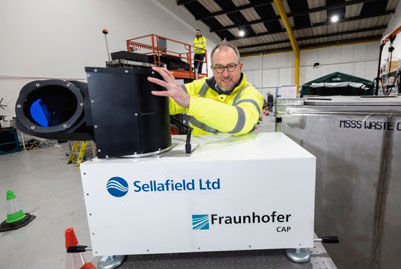
Scientists in Glasgow have developed pioneering “national capability” technology that can detect hydrogen leaks from a distance.A team at the Fraunhofer Centre for Applied Photonics (CAP) has been working with the nuclear industry, which has a store of nuclear waste, to address the significant challenge posed by the storage of this hazardous material. Through chemical reactions or radiolysis of water, nuclear waste can produce hydrogen, a highly flammable gas that can ignite and potentially explode when mixed with oxygen.
The Fraunhofer physicists have created a stand-off laser detection system which can scan large areas inside stores above waste containers, take hydrogen concentration measurements for each one and produce an H2 concentration map. This analysis can be repeated on a regular basis, allowing any changes to be identified and appropriate action taken.
Stand-off laser detection
The £1.5 M ($2.0 M) project, which has been taking place over seven years, was run by nuclear sector innovation specialists FIS360 Ltd on behalf of Sellafield’s Game Changers innovation program, which funds projects to find solutions for complex problems faced by the nuclear industry. This technology can now be applied more widely as the world moves away from the use of fossil fuels and towards a hydrogen-based economy with net zero targets.
The current focus of Fraunhofer CAP team is on creating a more compact, cheaper, hand-held device which can scan smaller areas. Funded by Innovate UK, the UK’s national innovation agency, and led by bp Plc, Fraunhofer CAP is delivering the project which is scheduled for completion in 2029.
Dr David Stothard, who leads the Fraunhofer CAP group specialising in stand-off detection, commented, “The problem with hydrogen is that it’s so easily ignited and burns with a completely clear flame. This means that if there is a leak and it ignites, you could walk right into the fire without knowing it – until it’s too late.
“Given the global pivot when it comes the use of hydrocarbons and the new emphasis on hydrogen, our work is progressing and expanding apace. Hydrogen processing plants, for instance, which convert energy from renewable sources, such as wind and solar power into green hydrogen, and are always on the lookout for leaks, could benefit greatly from our technology.
“What we are doing is developing sophisticated technology using lasers which minimise human interaction with an extremely dangerous gas on which society is becoming more reliant.”
Alex Allen, who leads Sellafield’s technology development for condition, monitoring and inspection, said, “This cutting-edge technology is critical to the Sellafield mission. Monitoring hydrogen enables us to infer how the waste is evolving and confirm it is evolving as predicted. The system allows us to monitor at distances of up to 80m and down to concentration levels as low as 50ppm.
“This is crucial for us as it provides assurance that waste is being stored safely. It could also be applied more widely across our owner the Nuclear Decommissioning Authority’s other legacy sites, delivering wider group benefit.”
 |  |  |  |  |  |  |
| © 2026 SPIE Europe |
|