 |
 |

11 Feb 2026
New photonic platform combines low loss, polarization independence, and full tunability.
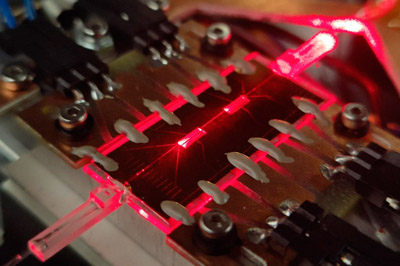
As quantum computers continue to advance, many of today’s encryption systems face the risk of becoming obsolete. A powerful alternative—quantum cryptography—offers security based on the laws of physics instead of computational difficulty. But to turn quantum communication into a practical technology, researchers need compact and reliable devices that can decode fragile quantum states carried by light.A new study from teams at the University of Padua, Politecnico di Milano, and the CNR Institute for Photonics and Nanotechnologies shows how this goal can be approached using a simple material: borosilicate glass. As reported in Advanced Photonics, their work demonstrates a high performance quantum coherent receiver fabricated directly inside glass using femtosecond laser writing.
Why glass?
Continuous variable (CV) quantum information processing—used in quantum key distribution (QKD) and quantum random number generation (QRNG)—relies on measuring the amplitude and phase of light waves. These measurements require a coherent receiver that combines a weak quantum signal with a stronger reference beam and analyzes their interference.
Most integrated receivers so far have been implemented on silicon. While silicon is well established and highly integrable, it suffers from polarization sensitivity and high optical losses, both of which reduce performance and stability in quantum communication systems.
Glass, on the other hand, is naturally polarization insensitive, extremely stable, and allows waveguides to be written in three dimensions with very low propagation loss. Using femtosecond laser micromachining, researchers can draw light guiding channels directly inside the material, creating compact photonic circuits without the fabrication complexity of semiconductor foundries.
The team fabricated a fully tunable heterodyne receiver—an essential component for CV QKD and CV QRNG—by writing the optical circuit directly into the volume of borosilicate glass. The chip includes: fixed and tunable beam splitters; thermo-optic phase shifters for precise electrical control; three dimensional waveguide crossings; and polarization independent directional couplers.
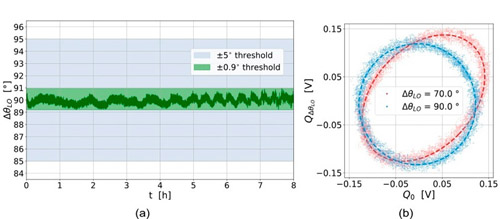
These elements allow the quantum signal and reference beam to interfere in a controlled manner so that two conjugate quadratures can be measured at once. The device also demonstrates:
Because of the chip’s low loss, tunability, and stability, it can support multiple quantum communication tasks without hardware changes. Using the chip as a heterodyne detector, the team implemented a source device independent QRNG, meaning the system remains secure even if the incoming optical state is untrusted. Thanks to its high noise suppression and stable quadrature measurements, the chip achieved 42.7 Gbit/s secure random bit generation, which represents a record high rate for this security model.
The same device was used to implement a QPSK based CV QKD protocol, where information is encoded in a four point constellation of quantum states. Over a simulated 9.3 km fiber link, the system reached a 3.2 Mbit/s secret key rate. This performance demonstrates that a glass based photonic front end can support state of the art CV QKD without the limitations associated with silicon platforms.
Ready for deploymentBeyond performance metrics, the work underscores the inherent advantages of glass for integrated quantum photonics:
These features support long term stability and resilience—qualities that could enable future use in field systems and even space based quantum communication missions. The authors emphasize that glass based integrated photonics may help bridge the gap between laboratory grade experiments and deployable quantum networks.
Leveraging these advantageous properties, the team demonstrated two core applications with the same chip: a source-device-independent QRNG, achieving a record-high secure generation rate of 42.7 Gbit/s, and a QPSK-based CV-QKD system, reaching a 3.2 Mbit/s secure key rate over a simulated fiber link of 9.3 km.
Beyond these achievements, the work highlights the potential of glass-based integrated photonics as a robust and versatile platform for quantum technologies. Glass is inert, stable, and cost-effective, enabling the fabrication of devices inherently resistant to harsh environmental conditions.
• This article was first published on spie.org.
 |  |  |  |  |  |  |
| © 2026 SPIE Europe |
|