


Penn State 4D-prints bio-inspired smart skin for breakthrough in surface engineering
Halftone-encoded printing method uses digital light processing to control hydrogel appearance.
10 February 2026
A project at Pennsylvania State University (Penn State) has developed a fabrication method that can print multifunctional smart synthetic skin.
Described in Nature Communications the technique could lead to configurable materials able to encrypt or decrypt information, enable adaptive camouflage or power soft robotics.
The idea for the material was sparked by the natural biology of cephalopods like the octopus, that control their skin's appearance to camouflage themselves from predators or communicate with each other. This is done using chromatophores in their skin and pigment sacs controlled by muscles.
Achieving a similar refined multi-faceted control in synthetic materials poses a significant challenge, noted Penn State, with existing ways to modify hydrogels falling short of simultaneous and coordinated control over dynamic features.
"Cephalopods use a complex system of muscles and nerves to exhibit dynamic control over the appearance and texture of their skin," commented Hongtao Sun from Penn State. "Inspired by these soft organisms, we developed a 4D-printing system to capture that idea in a synthetic, soft material."
Putting the principle into practice involved development of a halftone-encoded 4D printing method that enables simultaneous programmable control over optical appearance, mechanical properties, surface texture, and shape transformation within a single smart hydrogel film.
Penn State's solution relies on the creation of binary halftone patterns, composed of highly crosslinked "1" domains and lightly crosslinked "0" domains in the photocurable hydrogel. Controlling the layout of binary halftone patterns with varying domain sizes and spacing can then simulate continuous tones and grayscale.
Shape transformations reveal halftone images
The precise arrangement and integration of these local optical domains enable the overall hydrogel skins to conceal or reveal high-resolution, high-contrast halftone images in response to factors like solvent and temperature changes; a 2D-to-3D shape transformation as the hydrogel swells, said the project in its paper.
Printing the halftone patterns involved a dynamic mask within a digital light processing platform, with a resolution of 50 microns per pixel.
Two halftoning algorithms, one frequency-modulated (FM) and the other amplitude-modulated (AM), were developed to create the varying greyscale levels. The FM method affects the frequency of fixed-size "1" domains, brightening the tone; the AM method varies the size of the "1" domain while maintaining a constant frequency across hydrogel layers.
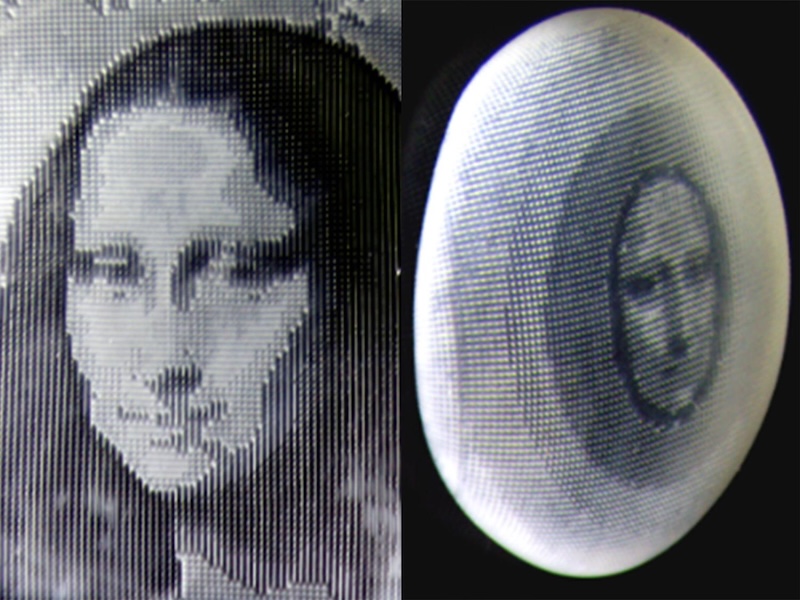
As proof of concept Penn State printed an image of the Mona Lisa, by creating a 720 x 720-pixel halftone image in both FM and AM forms. When the film was washed with ethanol, the film appeared transparent, showing no visible image. The Mona Lisa then became fully visible after immersion in ice water, or during gradual heating.
The project believes this optical printing approach should be broadly compatible with other stimuli-responsive materials, including liquid crystal elastomers and shape memory polymers. This could open up applications in areas such as soft robotics, flexible displays, optical sensing, smart actuators, biomedical devices, and secure communication technologies.
"The key feature lies in the ability to simultaneously couple and decouple mechanical, optical, and shape-morphing features," said the project in its paper. "Our printing technique creates multifunctional materials capable of dynamic behavior and information encryption."
Penn State wearable sensor tracks temperature and strain
February 12 2025

Diffraqtion aims high with $10M for 'quantum' camera platform
September 01 2026