



Report suggests $3BN market for optical satellite link hardware by 2030
Forecast from analyst company Yole sees sector entering industrial phase as Chinese rival to Starlink scales up activities.
19 November 2025 Business News

The emerging market for optical satellite communications is about to undergo a phase of rapid growth and industrialization, and should be worth $3 billion by 2030.
That's according to a new report from the France-based analyst company Yole Group, which suggests that the market value will be dominated by laser communication terminals (LCT).
Eric Mounier and colleagues at the Paris think-tank say that, by the end of 2024, there were already some 4000 LCTs in orbit, with that total dominated by Starlink deployments.
The Yole report states that the market for LCTs was worth $550 million in 2024 - accounting for more than 80 per cent of the total sector, augmented by optical devices (worth $60 million) and optical ground stations ($50 million).
2026 ramp
However, annual LCT shipments are expected to rise quickly - partly through continued Starlink expansion, but also thanks to launches for Amazon's "Kuiper" effort (just rebranded as "Amazon Leo") and China's "Guowang" low-Earth orbit project.
Seen as a rival to Starlink, Guowang calls for 13,000 satellites in total, with around 100 of those launched this year and a major ramp expected from 2026.
"Between 2024 and 2030, the optical satellite communication market will expand rapidly across terminals, devices, ground systems, and service applications," observes the Yole team.
"This reflects both the industrialization of laser communication technologies and their increasing deployment in large satellite constellations. This surge drives LCT system revenues to $2.4 billion in 2030, representing a 28 per cent compound annual growth rate (CAGR)."
In their analysis of the current supply chain, Mounier and colleagues identify Coherent, NKT Photonics and its parent company Hamamatsu, French firm Exail, and MACOM among the key providers of the components inside LCTs.
"The core device market, including photodetectors, laser sources, modulators, power amplifiers, and other ICs, will grow to almost $400 million by 2030, with a 37 per cent CAGR," they report.
For the smaller ground station segment, the Yole team identifies Coherent, NKT Photonics, Cailabs, and MPB Communications as key device suppliers.
Quantum links
One key trend identified in the Yole report is a shift towards "quantum-ready" interoperable links providing 100 Gb/s connectivity. "Terminals will deliver tens to hundreds of Gb/s per satellite, enabling multi-hundred-Tb/s networks across broadband, IoT, quantum, and defense missions," Yole predicts.
"The optical satellite communications roadmap is converging toward high-throughput, interoperable, and quantum-secure systems," added Mounier. "Photonic integration and wide-bandgap semiconductors are reshaping terminal performance and redefining what is achievable in space-based communications."
One company identified by Yole as a key provider of LCTs is Colorado-based Skyloom Global - a company now set to become part of the rapidly expanding IonQ business.
Focused mainly on quantum computing hardware, IonQ has completed a number of photonics-related acquisitions over the past couple of years, and also purchased a majority stake in the quantum-encrypted communications pioneer ID Quantique.
Founded in 2017, Skyloom is said to have delivered close to 90 optical terminals for US Space Development Agency (SDA) missions thus far, and to have demonstrated scalable production of LCT hardware.
IonQ CEO Niccolo de Masi said that the planned deal marked a "pivotal acceleration" for the quantum company, by adding high-bandwidth optical link capabilities to the firm's existing global quantum platform.
"These optical links form the backbone for quantum-secure communications and next-generation quantum networking and distributed quantum entanglement infrastructure," he added. "Skyloom's technology expands IonQ's total addressable market while increasing downlinking speeds for our existing offerings."
• Yole Group's report Optical satellite communication: scaling toward a multi-billion-dollar market is available now via the company's web site.

EPFL enhances super-resolution imaging from single camera exposures
September 09 2026
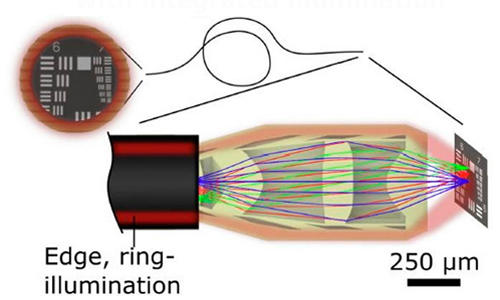
Stuttgart-led group combines illumination and microscopy in fiber bundle
September 09 2026

ESA Earth observation mission FLEX set to launch on September 15th…
September 09 2026



Oxxius looks to grow international footprint with €5M equity support
September 08 2026