


ETH Zurich images blood flow, neuron activity and glial cells in real time
Hybrid platform combining fluorescence and MRI expands neuroimaging toolbox.
01 October 2025 Research & Development
 A project led by ETH Zurich and the University of Zurich has developed a platform detecting both optical and MRI data from biological tissues.
Christened HyFMRI and described in Light Science & Applications, the system represents "a new approach for hybridizing multiplexed optical and MRI recordings," according to the project.
In particular the system should help increase understanding of how astrocytes, characteristic star-shaped glial cells found in the brain and spinal cord, are involved in neural processing.
"A critical gap currently exists in systematic understanding and experimental validation of the role of astrocytes in neurovascular coupling and their functional links with other brain cells," noted the team in its paper.
"Despite a broad selection of functional neuroimaging tools for multi-scale brain interrogations, no methodology currently exists that can discern responses from neural and glial cells while simultaneously mapping the associated hemodynamic activity on a large scale."
In principle fluorescence and MRI modalities can complement each other and answer this question, allowing direct measurement of both local neural activity and associated hemodynamic responses. Past research into using them together in an imaging platform includes a 2017 project combining ultra-high-field MRI and high-resolution two-photon microscopy.
But integrating concurrent fluorescence calcium recordings with fMRI is not straightforward, due to electromagnetic interference inside the MRI scanner.
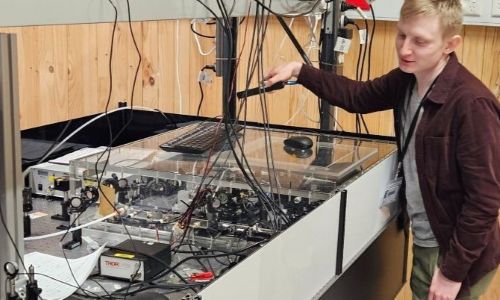
The project's solution was to incorporate a fiberscope-based optical imaging module and a custom surface radiofrequency coil into the bore of a preclinical MRI scanner, using custom 3D-printed components where necessary to bridge the two modalities.
Accelerating research into brain diseases
In trials studying stimulus-evoked brain responses in mice, HyFMRI successfully recorded cell-type-specific calcium signaling alongside whole-brain hemodynamics, revealing new details of how astrocytes are involved in coupling neuronal activity to localized changes in blood flow.
"HyFMRI holds several significant advantages over conventional photometry-based approaches and stand-alone widefield fluorescence imaging," said ETH Zurich.
"First, it can measure cortex-wide neural activity simultaneously with fMRI, making it particularly suitable for brain function studies at the level of large networks or circuits. Second, HyFMRI is minimally invasive and easy to implement, avoiding significant drawbacks of photometry-based approaches. And HyFMRI achieves a reasonable balance between spatial resolution and whole-cortical coverage."
Given its compact design, the HyFMRI platform holds potential for future integration with additional modalities, such as optoacoustic imaging, optogenetics, or transcranial ultrasound stimulation to answer more sophisticated questions.
"The integration of these two advanced imaging modalities addresses a long-standing challenge in neuroscience, capturing both cellular-level activity and whole-brain hemodynamics in the same experiment," noted the researchers. "This achievement could help accelerate research into brain diseases, enabling the development of more targeted therapies and deepening our understanding of brain function."
Diffraqtion aims high with $10M for 'quantum' camera platform
September 01 2026