 |

17 Dec 2025
...plus Photonics21 launches €5000 Innovation Award – sponsored by SPIE Europe and Hamamatsu.
With Europe facing more extreme weather, ageing infrastructure and rising demand for early-warning systems, authorities need broader and more continuous information than existing sensors can provide.Now a new €5 million EU-funded project has begun work to allow fiber optic cable lines under roads, fields and seas to double up as sensors capable of spotting earthquakes, monitoring traffic, and detecting changes in the natural environment.
An interdisciplinary team specialising in photonics is developing sensors that read tiny changes in the light travelling through fiber, to see whether Europe’s internet cables could soon do far more than carry data.
Recent incidents of accidental damage and suspected sabotage of subsea and terrestrial cables have highlighted how vulnerable Europe’s communications and energy networks can be. The project will test whether fibers can also act as an early-warning system for unusual vibrations or disturbances that may signal accidental or malicious tampering.
The work is being led by the CONNECT Research Ireland Centre, based at Trinity College Dublin, together with a network of academic and industrial partners across Europe. Calling themselves the “ICON” project, they offer more than environmental insight.
Infrastructure security
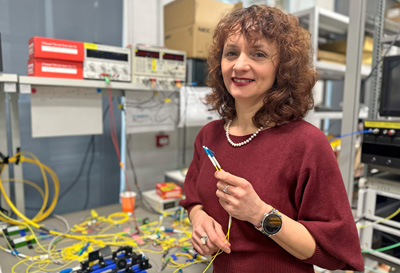
Dr Aleksandra Kaszubowska, of Trinity College, who is project coordinator, commented, “ICON takes critical infrastructure security to a new level, by including physical layer monitoring. Communication links are critical for energy production, transport and finance. Many fiber routes sit alongside gas pipelines, power lines or wind-farm links. As a result, the sensing system could also flag accidental or malicious damage to critical infrastructure. ICON offers much more than mere environmental monitoring.”
The project is based on a concept known as joint communication and sensing. This means the same strand of fiber carries internet traffic while also running a low-level optical signal used for measurements. The challenge is to let both tasks happen at once without affecting the quality of the connection.
To manage this, ICON is developing two key tools. The first is an “intent interpreter”, which converts simple requests into technical instructions. For example, if a civil protection agency wants to check for unusual ground movement along a particular route, the system works out how to run the measurement while keeping normal internet traffic flowing. The second tool is a digital twin: a live virtual model of the network that shows how the fibers are behaving at any moment. Operators can use it to test different sensing tasks before switching them on, helping to avoid disruption.The aim is to make better use of the infrastructure that is already there. “Millions of kilometers of fiber run across Europe,” Dr Kaszubowska said. “These cables are stable, widespread and highly sensitive. We want to understand how they can help us see what is happening in the world in real time, without building separate sensor networks.”
ICON will run for three years until 2027. The team will first test the sensing methods in controlled settings, then work with telecom operators and public agencies on pilot sites. Findings will be shared openly with industry and research bodies to help wider adoption.
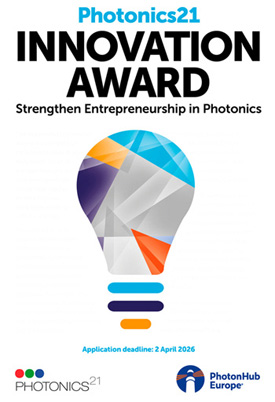
Photonics21 launches €5000 Innovation Award 2026
European industry platform Photonics21 has launched the Photonics21 Innovation Award 2026. This dedicated Innovation Challenge seeks to push for more entrepreneurship in photonics. The Photonics21 Innovation Award, sponsored by SPIE Europe and Hamamatsu, addresses PhD students, master students, young entrepreneurs, and makers alike who have an idea for a photonics product that can transform into a real business or product.
The idea can be already described in a Master or PhD thesis or in a business plan or the like. Any person active in the field of optics and photonics, may apply for the Photonics21 Innovation Award.
The winner will receive a cash prize of €5000 as well as an entrepreneurial skills coaching. The second and third winner will equally benefit from an entrepreneurial skills training by PhotonHub Europe. The deadline for applications is 2 April 2026. Here is the link to the competition website for further information.
 |  |  |  |  |  |  |
| © 2026 SPIE Europe |
|