 |

25 Mar 2026
AI will assist in efficient repairs to damaged submerged steel structures.
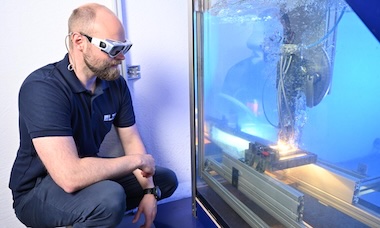
A collaboration between Germany's LZH, the Institute of Information Processing (TNT) at Leibniz University Hannover and research network OFTEC aims to develop a 3D printing platform for underwater repairs to steel.The project, studying robot and laser-based 3D printing with AI support for the sustainable repair of underwater steel structures and officially named "RoLaKI," envisages a platform able to repair underwater structures exposed to extreme conditions, such as offshore wind turbines, bridge piers or port infrastructure.
At the core of the project is the optimization of underwater laser-based 3D printing, and an investigation of how various process parameters influence layer formation and the ultimate processing results.
Using this data, RoLaKI will then train an artificial intelligence (AI) model that learns autonomously and predicts optimal parameters for new repair tasks. The team aims to design an AI-supported path planning system that calculates the best way to fix a damaged area.
Carrying out an additive manufacturing operation underwater is a challenging prospect with any feed material. Since 2024 DARPA has funded research into 3D concrete printing as a route to construction and repair of underwater habitats, with the process being demonstrated successfully in 2026 by Cornell University and others. This has mainly focused on optimizing a recipe for concrete and ceramics that can be piped into place and allowed to set in an underwater environment.
3D printing of metals and the consequent need for a laser to act on the feed material underwater adds further levels of difficulty. A 2024 survey of the topic in Applied Sciences noted that only limited studies had been made, with most of those involving titanium alloys. Researchers have employed specially designed drainage nozzles and gas flows intended to create a local dry chamber, within which a laser metal deposition operation can proceed.
Control of optical parameters and materials feed
LZH already has experience in underwater laser operations, including its 2022 use of laser-induced detonation of submerged ordnance. In that project a laser mounted on a diving robot is used to make defined cuts into the underwater shell, and then to trigger a low-order detonation.
Researchers at the Hanover center are also working in the Nerites project, aiming to carry out laser-induced breakdown spectroscopy on undersea cultural artifacts. This involves adapted optical configurations, laser parameters and detection strategies to counter the scattering, absorption and bubble dynamics affecting all optical paths in a submerged LIBS operation.
Part of RoLaKI's research with be the development of comparable special laser processing optics for the 3D printing of steel, designed to combine the necessary optical components with the wire feed used in the coating process.
"The optic will be mounted on a fine positioning system attached to a magnetic crawler that transports the system underwater to the damaged site," commented LZH. "This fine positioning system makes it possible to build weld seams precisely next to and on top of each other. By the end of the project, the partners aim to demonstrate the entire process using a prototype."
 |  |  |  |  |  |  |
| © 2026 SPIE Europe |
|