 |

09 Mar 2026
Cailabs is contributing new compact process head based on its MPLC beam shaping technology.
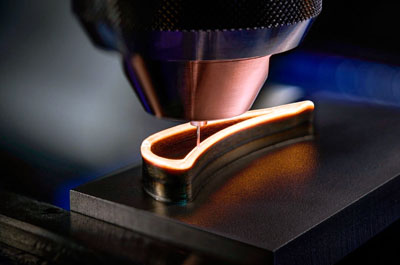
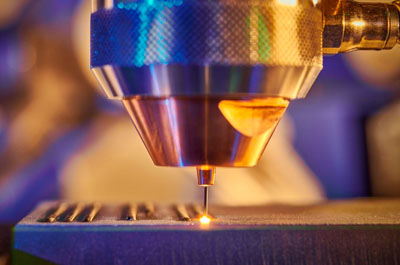
Fraunhofer ILT and Cailabs are entering a development partnership to advance wire-based laser material deposition for demanding industrial applications. Cailabs, headquartered in Rennes, France, is contributing a new compact process head based on its MPLC beam-shaping technology.The head weighs less than 5 kg and allows the use of laser powers above 12 kW. This combination of compact size, high available laser power and precise beam shaping has not been available in this form before. Based on this, Fraunhofer ILT develops and qualifies suitable process parameters for different component geometries and use cases.
In many industrial processes, wire serves as an additive material to build up or repair components. Wire is easy to handle, safe to use and can be fed precisely. It is often more cost-efficient than powder, and some alloys are only available in wire form. However, wire-based deposition heads have traditionally been more complex and heavier than powder-based heads.
Fraunhofer ILT and Cailabs are entering a development partnership to advance wire-based laser material deposition for demanding industrial applications. Cailabs contributes a new, particularly compact process head based on its MPLC beam-shaping technology. Building on this, Fraunhofer ILT develops suitable process parameters and qualifies the system for various applications across different industrial sectors. The precise beam profile supports a consistent energy input into the wire. This enables uniform deposition even where fine contours or locally confined material buildup are required.
Compact process head
The aim of the collaboration is a compact head with a total weight of less than 5 kg, light enough to be mounted directly on a robot arm and smoothly integrated into existing systems. At the same time, the partners intend to enable the use of laser power levels above 12 kW. This will support the repair and buildup of larger components and help reduce processing times.
“We have already developed wire-based deposition processes for critical applications such as aerospace, energy systems and tooling,” said Dr. Thomas Schopphoven, Head of Laser Material Deposition at Fraunhofer ILT. “This experience flows directly into process control, material selection and analysis of melt pool dynamics.”
The team led by Schopphoven is currently defining parameter windows for different processing scenarios using physics-based simulations. This includes tuning wire feed, wire diameter, laser power and guideway strategies for different materials. In parallel, the robot-guided system environment is being set up, where the Canunda-DED head will be tested.Cailabs’ MPLC technology uses several phase-shaping planes to form stable and reproducible beam profiles. The approach has proven effective in fields where high beam quality is crucial, such as aerospace, optical communications and industrial laser processing. It is low-loss, robust and stable even at high power levels.
Because the new head remains compact, it can be mounted directly on a robot arm. This opens new possibilities: robots and production systems gain access to areas that were previously difficult to reach with larger, stationary deposition heads, for example when repairing small components or inner contours.
The two partners are currently preparing system trials. The focus is on coordinating beam profile, wire feed and guideway to achieve stable operation under continuous use. In parallel, preparations are being made for real industrial use cases, such as the repair of complex component geometries or the buildup of fine edges.
• The latest leading-edge developments in laser technology will be highlighted at the 15th AKL – International Laser Technology Congress, taking place in Aachen, Germany, from April 22 to 24, 2026. As part of the conference program, Cailabs will contribute a technical presentation.
 |  |  |  |  |  |  |
| © 2026 SPIE Europe |
|