 |

02 Mar 2026
Varying beam shape lets laser cut bone deeper than previously possible.
Laser bone cutting, or osteotomy, is a potentially attractive route to precise removal of bone during surgery, but clinical translation remains limited by slower cutting speeds and ablation depths than mechanical tools.A project at the University of Basel has now demonstrated a laser system able to cut much deeper and faster than previous laser platforms.
Described in Nature Scientific Reports, the findings could assist wider clinical adoption of laser osteotomy as a viable surgical procedure.
"Lasers are already used for soft tissue," said the project. "In the case of bone, however, cuts were previously only possible up to a depth of 2 to 3 centimeters, far too shallow for joint implants for example."
Previous research into improving these performance metrics at the University of Basel included the 2023 platform in which laser breakdown spectroscopy and OCT provided key feedback on cutting depth and tissue type during bone removal.
Another past study of laser bone removal, this time at LZH, also used OCT to monitor the progress of the cutting procedure, visualizing the tissue layers under the bone in spinal canal stenosis operations.
The new Basel study investigated how key laser parameters affected the cutting speed and depth, based on the theory that the shape of the laser pulse might be one reason for insufficient cutting performance. Although wavelength changes had been investigated for this purpose, other pulse characteristics have received less study.
"A key factor for cutting efficiency is the fact that with the conventional laser profile, the walls of the cut absorb part of the energy," commented Ferda Canbaz from Basel's Center for Intelligent Optics.
"At a certain depth, the energy at the bottom of the cut is not sufficient to cut any deeper. Increasing the energy of the laser beam would not be a good solution. This could char the bone and have a negative impact on the healing process."
Narrowing the gap between laser and standard mechanical tools
The Basel team modified its laser pulse from a Gaussian profile to a top-hat shape, theorizing that a beamshaping operation would prevent laser energy being consumed by the walls of the cut. A "capped" profile allows the energy of the laser beam to be distributed more evenly across the entire surface before dropping abruptly at the edge.
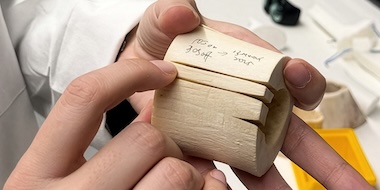
In trials comparing a Er:YAG laser with top-hat and Gaussian intensity distributions when cutting bovine femur cortical bone, the top-hat distribution achieved a cutting depth of 44 millimeters at a material removal rate of 0.42 cubic millimeters per second. The standard Gaussian laser cut only about 26 millimeters deep and removed 0.24 mm3.
The researchers are now working on further optimizing the cutting depth and speed of their laser, since the laser-blade is still significantly slower than a metal one, noted the Basel team.
In one second a mechanical saw can remove 11 cubic millimeters, considerably more than the new improved laser benchmark. This means that the laser is still too slow, even though it now approaches the required depth for the first time.
"As part of the next steps, we will also need to investigate how we can adapt the system to the more complex situation in the body," said Ferda Canbaz. "There, it is also about protecting the surrounding tissue."
 |  |  |  |  |  |  |
| © 2026 SPIE Europe |
|