 |
 |

30 Mar 2026
Preview of AKL Conference 2026, which includes sessions on high power lasers and novelapplications.
Laser technology is breaking into new dimensions: ultrashort-pulse and continuous-wave lasers with average powers in the multi-kilowatt range promise to boost efficiency for material processing and pave the way for entirely new fields of applications. At the AKL’26 – International Laser Technology Congress, taking place from April 22 to 24, 2026, in Aachen, Germany, several sessions will focus on multi-kW lasers.“The average power of Ultrashort pulse lasers is reaching the double-digit kilowatt (kW) range thanks to developments at the Fraunhofer Cluster of Excellence Advanced Photon Sources – CAPS,” said Dr. Jochen Stollenwerk, acting director of Fraunhofer ILT (ILT), also in Aachen.
The power of continuous-wave lasers is already in the range of several hundred kW. Such power levels make the laser attractive for previously unattainable target markets. In tunnel and deep drilling or in mining, high-power lasers could help shatter rock and massively accelerate existing processes. In shipbuilding and plant construction, high average powers enable more efficient and precise drilling, cutting, and joining processes for thick materials and high-strength steels.
High-power lasers are also needed to process and functionalize large metallic, glass, and ceramic surfaces in parallel using multi-beam methods or optical stamps. Stollenwerk is convinced that “these methods will trigger a surge in efficiency in laser material processing.” Laser processes could then also be used to maintain rail networks or pipelines.
Another AKL speaker Dr. Hagen Zimer, CEO of Laser Technology and a member of the Executive Board of Trumpf, decribes a “new era of laser technology.” Industrial lasers with 50 kW and more are now a reality, and the first 100+ kW applications are already on the horizon, he believes. The ultra-high-power lasers developed for this purpose will not only accelerate processes, but fundamentally transform them. The expert sees users of laser technology at a strategic turning point. “Much of what previously failed at the limits of feasibility is now becoming a reality,” he said. This also applies to cost structures as prices for laser systems are falling.
AKL’26 highlights market potentialStollenwerk and Zimer will delve deeper into this trend during AKL’26. In the Gerd Herziger Session, they will also discuss the economic and technological potential of high-power and high-energy lasers together with senior managers from Coherent, IPG Photonics, and Amplitude Laser.
Given the wealth of new applications for high-power, high-pulse-energy lasers, Prof. Constantin Häfner, Executive Board Member for Research and Transfer at the Fraunhofer Society, sees “huge, still completely untapped markets for photonics.” He estimates their long-term revenue potential at several hundred billion euros.
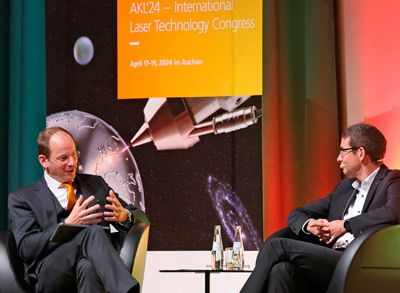
“Laser research is far from over. On the contrary—60 years after its invention, things are just really getting started,” said Häfner at AKL’24. The renowned fusion expert will use AKL’26, taking place from April 22 to 24, to review the progress to date, shedding light on the status of fusion research and the development of industrial supply and process chains.
Process and application expertise
Fusion power plants and secondary sources require high pulse energy and high average power with high efficiency and high pulse contrast. Industrial manufacturing processes, in contrast, need reliable pulsed and continuous-wave lasers with high average power and excellent beam quality at moderate pulse energies.
The ILT announcement avout the forthcoming conference states, “These technologies are paving the way for more efficient laser processing, when combined with innovative—and in some cases AI-supported—process strategies, as well as robust fibers, optics, and coatings. In particular, parallelization promises significant productivity gains. To achieve this, the beam from the high-power source is split into dozens of individual beams that can be directed independently of one another.”
Implementing such multi-beam approaches requires fast, precise beam guidance systems. This is where a novel planar galvanometer scanner developed at ILT comes into play, which the institute’s latest spin-off will present at AKL’26. The miniaturized system is suited for multi-scanner systems and operates significantly faster and more precisely than previously available solutions.ILT is also advancing new beam-shaping approaches to optimally adapt beam shapes to components and machining processes. Using optical neural networks, among other technologies, the Aachen-based researchers can create virtually any three-dimensional beam profile or optical stamp. In this process, the laser spot no longer scans the workpieces in fine lines.
Instead, the light structures entire areas, which in some cases speeds up processing by a factor of five. “What makes optical stamping special is the combination of speed, precision, and flexibility,” said Sönke Vogel, team leader for 3D structural ablation at Fraunhofer ILT.
In principle, the USP process—in which a spatial light modulator (SLM) shapes the beam into an optical stamp—is suitable for any application requiring periodic microstructures, whether in metal, hard ceramic materials, or glass. In addition to the multi-beam method and optical stamping, the Aachen-based institute is pursuing further approaches for converting high average laser powers into more productive material processing.
 |  |  |  |  |  |  |
| © 2026 SPIE Europe |
|