


University of Warwick applies terahertz imaging to real-time diagnostics
A compact platform could help translate THz technology into clinics.
24 March 2026
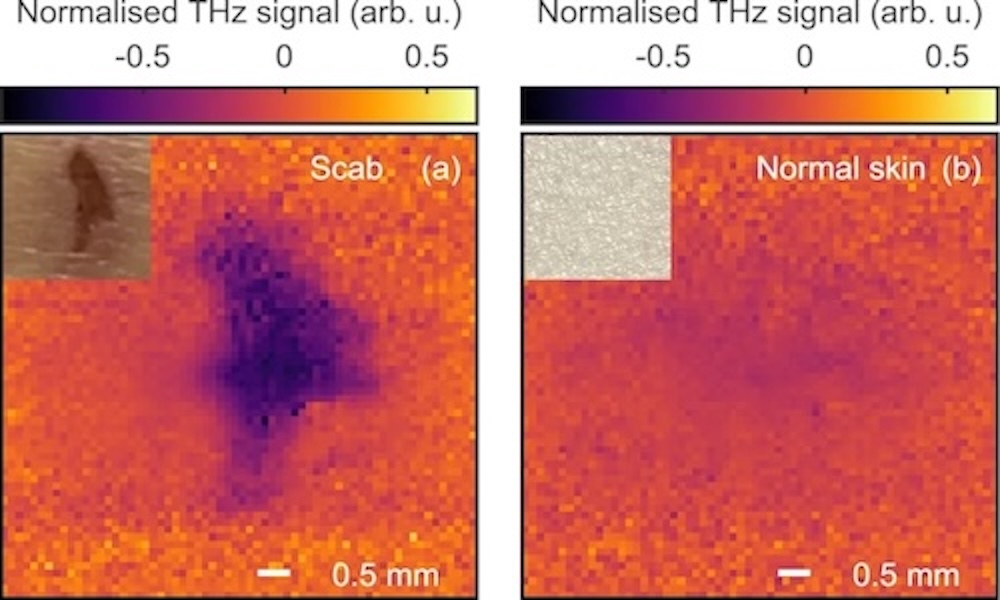
THZ imaging for clinical use. Credit: University of Warwick/Nature Communications.
Terahertz (THz) imaging, using part of the electromagnetic spectrum between infrared and microwave, is a promising diagnostic approach, thanks to the inherently non-ionizing nature of THz radiation and its sensitivity to water content of tissues.
However, most existing THz imaging systems are bulky and slow, limiting their use outside specialist labs.
A team from the University of Warwick and the University of Exeter has now developed a fully fiber-coupled THz imaging system that significantly improves the speed, resolution, and clinical practicality of the technique.
Published in Nature Communications, the findings could point to real-time non-invasive THz imaging from a compact platform suitable for routine clinical use.
"Terahertz imaging has shown immense promise for biomedical diagnostics, but its translation into real-world clinical tools has been hindered by bulky systems and slow acquisition speeds," said Emma MacPherson from Warwick's Terahertz Research Group.
"This is an exciting breakthrough as the fiber coupling means that the system can be flexible and compact, so it can function as a handheld device or be integrated with a robot."
Recent advances in THz biomedical imaging have included the 2025 project at Stony Brook University which used THz polarimetry as a way to detect microscopic tissue changes associated with skin damage from burns, as an alternative to using water content as the source of diagnostic image contrast.
Meanwhile steps towards more compact and convenient THz platforms have been underway, such as the work at China's Beihang University on incorporating THz emitters into on-chip architectures for quantum optics and sensing.
New possibilities for rapid, non-invasive diagnosis
The Warwick project aimed to exploit attenuated total reflection (ATR), a technique employed in infrared spectroscopy whereby incident radiation undergoes total internal reflection at the point where a prism meets a sample. An evanescent field is generated at that point, extending into the analyte sample and stimulating an optical response.
THz ATR has been used for materials characterization and bioimaging, noted the Warwick team in its paper, but doing so in a versatile all-fiber-coupled broadband platform has not been explored until now.
The new fiber-coupled architecture was found to deliver near video-rate imaging with a spatial resolution of around 360 microns, more than five times faster than current state-of-the-art systems according to the researchers. In proof-of-concept demonstrations, the system successfully distinguished between different types of biological tissue, including fat and protein in pig samples, and was able to capture real-time images of a wound on a volunteer’s arm.
Its compact design means it could be used directly on patients, either as a handheld device or as part of robotic surgical tools, opening up new possibilities for rapid, non-invasive diagnosis.
"This advance brings terahertz imaging closer to everyday clinical use," said Emma MacPherson. "For patients, that could mean faster answers and fewer invasive procedures - enabling clinicians to assess wounds or suspicious skin lesions in real time, without exposure to ionizing radiation, and to make more confident decisions at the point of care."
Diffraqtion aims high with $10M for 'quantum' camera platform
September 01 2026