 |
 |

30 Mar 2026
Jiangsu University creates light-absorbing material for use in low temperature environments.
A project group including China's Jiangsu University of Science and Technology and partners has demonstrated how laser-patterned surface structures can help a material resist icing up in cold environments.Described in International Journal of Extreme Manufacturing the research could help designers of wind turbines, power infrastructure and aircraft, where icing causes substantial energy losses as well as mechanical safety risks.
Creating a superhydrophobic surface as a route to resisting ice formation has been studied for some time, with such surfaces able to suppress heat exchange and enable passive anti-icing without external energy input.
However, this approach remains challenging to sustain in regions where cold conditions are accompanied by weak levels of sunlight illumination, noted the project in its paper, while ultra-low temperatures interfere with the thermodynamic ice-resisting mechanisms intended.
"There is an urgent need to develop novel, durable, and flexible films that can deliver efficient anti/de-icing functionality under the dual stringent conditions of extremely low temperature and weak illumination," commented the project group.
The team's solution involves creation of a flexible multilayer membrane with carbon nanotubes embedded in a silicon skin. A nanosecond-pulse 355-nanometer laser then carves a precise microscopic grid of pillars into the material, selectively exposing the underlying carbon nanotubes with a line spacing of 50 microns. This creates a jagged, multi-scale surface that heavily traps incoming light.
Such a laser-induced multi-scale hierarchical structure (MHS) increases surface roughness and effectively suppresses ice nucleation and crystal growth, noted the project.
Anti-icing film for curved wind turbine blades and aerospace components
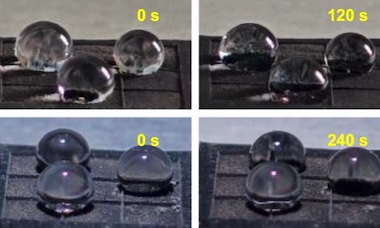
When put to the test, the resulting film absorbed 98.86 percent of incoming visible light and converted 89 percent of it directly into thermal energy. In testing chambers chilled to -50 °C and illuminated by only 20 percent of normal sunlight - mimicking heavy cloud cover or polar twilight - the surface successfully delayed water droplets from freezing for 720 seconds.
After studying the structure's behavior, the project observed how the laser-etched material resisted icing in two stages. First the laser-cut microscopic pillars force landing water droplets to rest exclusively on their sharp tips, trapping a continuous pocket of air underneath to act as a thermal blanket.
When this effect is overcome and the water droplets freeze, the exposed carbon nanotubes force light to bounce continuously between the pillars and maximize energy absorption. This localized heat is channeled directly to the exact points where the ice touches the pillar tips, creating a thin, lubricating layer of liquid water and trapped air.
The film exhibits high flexibility and is suitable for curved or irregular surfaces, making it potentially valuable for a range of real-world industrial applications. The project's next steps will be scaling up the laser fabrication process for large-area production, and assessing the material's long-term endurance under realistic, unpredictable outdoor weather conditions.
"This offers promising applications in offshore and onshore wind turbines, aerospace and aviation components, power transmission systems and marine vessels or offshore platforms," wrote the project.
 |  |  |  |  |  |  |
| © 2026 SPIE Europe |
|