


Neurophos raises $110M for photonic chips based around metamaterial modulators
Texas startup's series A round backed by Bill Gates, Microsoft, Aramco, Bosch, and others.
27 January 2026
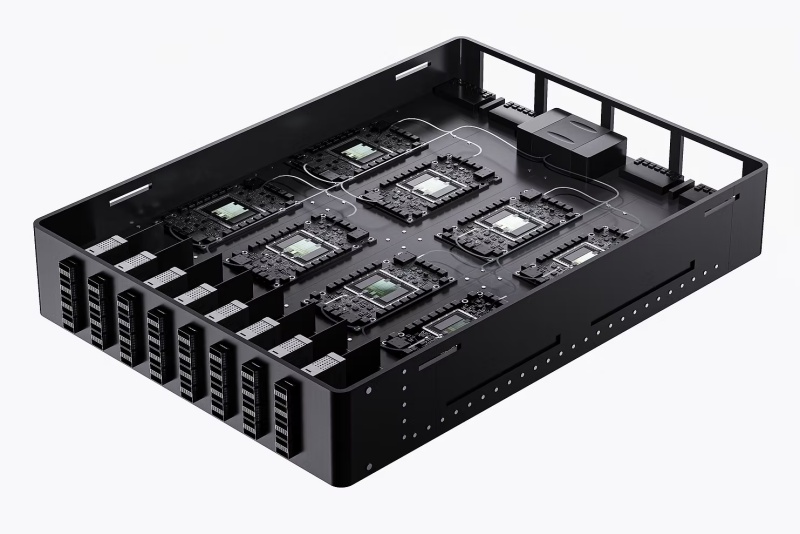
Neurophos, a startup company based in Austin, Texas, that is working on photonic chips based around metamaterial optical modulators, says it raised $110 million in a series A round of venture funding.
The latest cash injection, which brings total funding to $118 million, is set to accelerate delivery of the firm’s first integrated photonic compute system, including what it calls “datacenter-ready optical processing unit (OPU) modules" aimed at artificial intelligence (AI) applications.
That hardware is expected to become available for initial evaluation by potential customers this year, with the first commercial systems and a ramp in production eyed for 2028.
The company is also expanding from its Austin headquarters to open an engineering site in San Francisco that is slated to meet early customer demand.
Gates Frontier, the investment vehicle set up by Bill Gates, led the oversubscribed round, alongside support from Microsoft’s “M12” fund, Carbon Direct Capital, Aramco Ventures, Bosch Ventures, MetaVC Partners, Tectonic Ventures, Space Capital, and several others.
AI compute efficiency boost
According to CEO Patrick Bowen, who co-founded the firm after researching metamaterials at Duke University and setting up Metacept Systems, that cutting-edge optical technology is at the heart of the Neurophos offering.
“Moore's Law is slowing, but AI can't afford to wait,” he said. “Our breakthrough in photonics unlocks an entirely new dimension of scaling, by packing massive optical parallelism on a single chip.
“This physics-level shift means both efficiency and raw speed improve as we scale up, breaking free from the power walls that constrain traditional GPUs.”
Neurophos claims that the adoption of metamaterials is the key to delivering tiny optical modulators whose size is measured in microns and represents a four-order-of-magnitude level of miniaturization.
And in a LinkedIn post company CTO Hod Finkelstein suggested that the firm’s OPUs would redefine AI compute infrastructure by improving power efficiency - the Achilles’ heel of AI data centers - by a factor of 100 over state-of-the-art GPUs.
“Our OPUs will not only enable the next generations of data centers, but will do so while dramatically reducing the environmental impact,” he wrote. “Our team is innovating in silicon photonics, high-speed mixed-signal VLSI, optics, lasers, and semiconductor devices.”
Optical architecture for machine intelligence
Microsoft, along with Meta, Google, and others, is currently spending hundreds of billions of dollars on the build-out of AI data centers largely deploying Nvidia-sourced GPUs. Michael Stewart, managing partner at the computing giant’s M12 venture unit, commented:
“As the AI industry grapples with a surge in demand that tests our ability to satisfy with compute and power, disruptive approaches to compute may open routes to sustained or accelerated systems scaling that will be needed before the end of the decade.
“With their approach to hyper-efficient optical computation, the Neurophos team have advanced swiftly from a working proof of concept towards a realistic plan to deliver products on a timeline we can underwrite and believe in.”
In a separate LinkedIn post, M12 said that Neurophos had developed a manufacturable OPU that compressed GPU-scale computing power into a "dramatically smaller, cooler, and more sustainable form".
Chris Alliegro, Stewart’s counterpart at MetaVC Partners, added: “Neurophos is addressing the only problem that really matters for the future of AI: the limits imposed by silicon.
“Their optical architecture provides the foundation for the next generation of machine intelligence.”
Diffraqtion aims high with $10M for 'quantum' camera platform
September 01 2026