



Wind and solar lead German public power generation in 2025 – for first time
Renewables accounted for 56% of total; PV up 21% over 2024 has overtaken brown coal.
05 January 2026
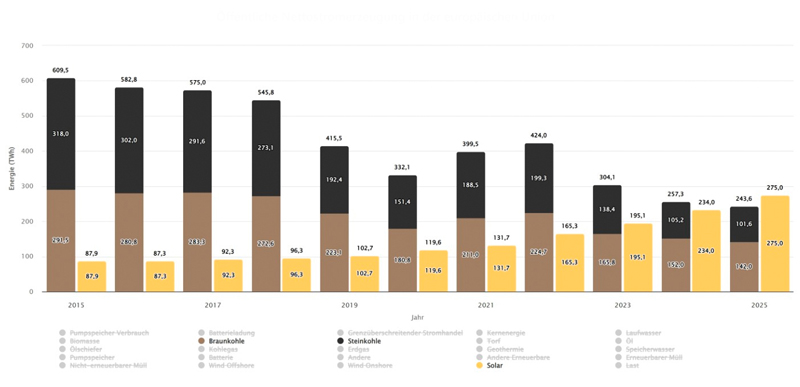
In 2025, the share of renewables in Germany’s net public electricity generation amounted to 55.9 percent, as in the previous year. Wind power again took first place as the strongest net electricity producer, followed by photovoltaics, which increased its production by 21 percent in 2025 – and overtook lignite for the first time (lignite or “brown coal,” is the lowest quality form of coal due to its relatively low carbon content).
In fact, the country’s share of electricity generation from fossil fuels stagnated in 2025, with the decline in lignite-based electricity generation being offset by rising natural gas consumption. The analysis is based on the energy-charts.info data platform of the Fraunhofer Institute for Solar Energy Systems (ISE).
Wind power was the strongest net electricity producer in Germany, although production was 3.2 percent lower than in the previous year at 132 terawatt hours (TWh) due to poorer wind conditions. Onshore wind accounted for around 106 TWh, while offshore wind generated around 26.1 TWh.
Photovoltaic systems generated approximately 87 TWh of electricity in 2025. Of this, approximately 71 TWh was fed into the public grid and a remarkable 16.9 TWh was consumed by the producers themselves. Total production increased by approximately 15 TWh, or 21 percent, compared to the previous year, moving photovoltaics into second place in its share of public net electricity generation.
By the end of 2025, installed solar capacity stood at 116.8 gigawatts of module capacity (DC), with approximately 16.2 GWDC of net capacity added over the course of the year (equivalent to 14.3 GWAC). To meet the set targets for 2026, however, newly installed photovoltaic capacity must increase to 22 gigawatts this year.
Europe-wide trend
The sharp rise in solar power generation in 2025 is an EU-wide trend. In EU countries, electricity generation from PV exceeded the combined total from lignite and hard coal (243 TWh) for the first time, reaching 275 TWh. In the past ten years, photovoltaic generation has tripled, while coal-fired power generation has fallen by 60 percent. In 2025, approximately 41.1 TWh of electricity was produced from biomass in Germany (2024: 37 TWh), of which 36 TWh were fed into the grid and 5.1 TWh were consumed internally. Hydropower produced only around 17.8 TWh (2024: 22.3 TWh) of electricity. At 655 l/m², precipitation in Germany was 27 percent lower than in 2024 (902 l/m²) and 17 percent below the average for the reference period 1961 to 1990 (789 l/m²).

In 2025, the renewable energy sources of solar, wind, water, biomass, and geothermal energy collectively produced approximately 278 TWh, of which 256 TWh was fed into the public power grid and 22 TWh was consumed internally. In all, generation from renewable energy sources increased by 6 TWh compared to the previous year.
Nevertheless, net renewable electricity generation falls well short of the target of 346 TWh set for 2025. The main reason for this, explains the ISE report, “is the failure to expand onshore and offshore wind power: due to differences in full-load hours, the shortfall in onshore wind power has roughly twice the impact on electricity volumes as the shortfall in offshore wind power, which has around 3.5 times the impact.”
Battery storage systems have shown a particularly dynamic development, says ISE. In general, high intraday electricity price fluctuations make batteries an attractive option, while the sharp price drop due to scaling effects in the mobility sector favors their investment. Accordingly, interest is growing in grid connections for large-scale battery storage systems.
Depending on the scenario, Fraunhofer ISE’s models show a battery storage requirement of 100 to 170 GWh by 2030. “The ramp-up of large-scale battery storage is fundamentally changing the way the German electricity system works. These developments require battery storage to be explicitly considered for expansion planning, system planning, and electricity market design,” said Leonhard Gandhi, project manager of the Energy Charts at ISE.
Generation from fossil fuels remains constant but imports decline
Net electricity generation from lignite-fired power plants fell by 3.9 TWh to 67.2 TWh. Gross electricity generation fell to the level of 1961. Net production from hard coal-fired power plants for public electricity consumption rose slightly to 26.7 TWh (2024: 24.3 TWh). Gross electricity generation from hard coal was at the 1952 level. Natural gas power plants produced 52.4 TWh net for public electricity supply and 26.1 TWh for industrial self-consumption. Production was thus 3.7 TWh above the previous year's level.
According to initial projections, carbon dioxide emissions from all sources of German electricity generation amounted to 160 million tons (the level of 2024), which is 58 percent lower than at the start of data collection in 1990. Emissions from coal-fired power generation rose by 4 percent compared to the previous year and fell by 69 percent compared to 1990.
Xcimer in line for more fusion funding
October 08 2026

Ghana Photonics & Optics Lab promises new future for photonics
October 08 2026


Nobel Prize for Medicine goes to optogenetics architects
October 06 2026
Volantis raises $88M with AI memory breakthrough claim
October 06 2026