


Linköping University prints conductive polymers with visible light
Avoiding UV wavelengths allows electrodes to be created on fragile living surfaces.
18 December 2025 Research & Development
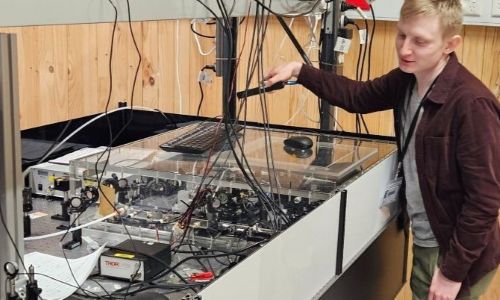
 A project at Sweden's Linköping University and Lund University has developed a process for printing conductive polymers with visible light.
This could lead to improved techniques for recording the brain activity in living animals, or to novel devices printed on glass and textiles. The study was published in Angewandte Chemie.
"I think this is something of a breakthrough," commented Xenofon Strakosas from Linköping's Laboratory of Organic Electronics (LOE). "It's another way of creating electronics that is simpler and doesn't require any expensive equipment."
Conducting polymers, in which the electronic properties of semiconductors are combined with the processability and flexibility of plastics, offer potential new approaches to sensing and electronics, but making them into usable components has remained challenging.
"Despite advances in LED-based technology, photopolymerization of conjugated polymers remains limited, yielding materials with subpar electrochemical performance," noted the project in its paper. "Reported methods typically rely on UV light, which can degrade sensitive structures."
The project has now succeeded in creating a method where polymerization can be driven by visible light, thanks to specially designed monomers developed by the researchers. This visible light photo-induced polymerization (VLIP) operation avoids toxic chemicals or harmful UV light, and no subsequent processes are needed to create the electrodes.
Recording brain activity
Through careful selection of precursor monomers and control of subsequent synthesis, the project created a new class of water-soluble organic monomer demonstrating not only VLIP potential but also the necessary capacitance and conductivity.
Altering the chemical composition can influence the polymerization window of the materials, as when the team introduced a particular dye molecule sensitive to red wavelengths. Since red light offers better tissue penetration, a property already exploited by several infra-red bioimaging techniques, this could enable the formation of conducting polymer patterns within biological structures, noted the team.
"The electrical properties of the material are at the very forefront," said Tobias Abrahamsson from LOE. "As the material can transport both electrons and ions, it can communicate with the body in a natural way, and its gentle chemistry ensures that tissue tolerates it - a combination that is crucial for medical applications."
As a first test of its use for biosensing, the project used the visible-light polymerization method to create photo-patterned electrodes directly onto the skin of anesthetized mice. The results showed "a clear improvement in the recording of low-frequency brain activity compared to traditional metal EEG electrodes," commented the team.
The VLIP process could be applicable to organic electronics in general, but especially to bioelectronic diagnostics and therapy, neural applications, and organic electrochemical device technologies, said the project's paper.
"As the method works on many different surfaces, you can also imagine sensors built into garments," commented Abrahamsson. "In addition, the method could be used for large-scale manufacture of organic electronics circuits, without dangerous solvents."
Diffraqtion aims high with $10M for 'quantum' camera platform
September 01 2026