


Researchers generate and detect ultrashort UV-C laser pulses at fs timescales
Nottingham and Imperial team say approach has applications in optical wireless, materials processing, and imaging.
01 December 2025 Research & Development
 UV-C light is a type of ultraviolet light with shorter wavelength and more energy than UV light of type A and B. Photonic components operating in the UV-C range can unlock new opportunities across science and technology, such as super-resolution microscopy, material processing applications, sterilization, and medical imaging.
Now a UK-based team of scientists have developed a new platform for the generation and detection of ultrashort UV-C laser pulses on femtosecond timescales. They say that this achievement "could unlock new opportunities for transforming optical wireless communication systems, material processing applications and medical imaging".
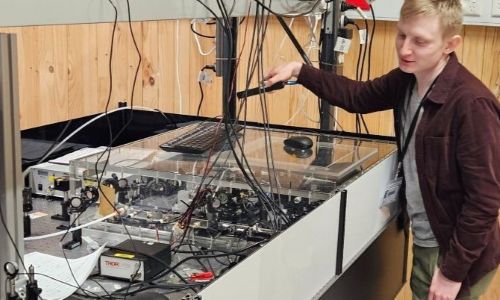
The scientists, from the University of Nottingham's School of Physics and Astronomy and Imperial College London, have developed a new platform for the generation and detection of ultrashort UV-C laser pulses.
The work is described in Nature.
The source produces pulses of femtosecond duration. These pulses are detected at room temperature by sensors based on ultrathin (two-dimensional, 2D) materials.
Professor Amalia Patané, from the University of Nottingham, led the development of the sensors. She commented, "This work combines for the first time the generation of femtosecond UV-C laser pulses with their fast detection by a new class of 2D semiconductors. These can operate over a wide range of pulse energies and repetition rates, as required for many applications."
Other applications
Strong atmospheric scattering of UV-C light also offers possibilities in modern optical wireless communication systems. Despite its vast potential, the widespread adoption of UV-C technology remains limited by lack of suitable materials and photonic components.
Ben Dewes, PhD student at Nottingham, added, "The detection of UV-C radiation with 2D materials is still in its infancy. The ability to detect ultrashort pulses, as well as to combine the generation and detection of pulses in free-space, helps pave the way for communication between autonomous systems and robotics."
Furthermore, Professor John Tisch, of Imperial College, said, "We have exploited phase matched second-order processes in nonlinear optical crystals for the efficient generation of UV-C laser light. The high conversion efficiency marks a significant milestone and provides a foundation for further optimization and scaling of the system into a compact source."
Diffraqtion aims high with $10M for 'quantum' camera platform
September 01 2026