


Rome-led group progresses toward practical photonic quantum neural networks
Simple adaptive method' makes optical quantum processors behave like neural networks.
25 November 2025 Research & Development
 Machine learning models called convolutional neural networks (CNNs) power technologies like image recognition and language translation. A quantum counterpart-known as a quantum convolutional neural network (QCNN)-could process information more efficiently by using quantum states instead of classical bits.
Photons are fast, stable, and easy to manipulate on chips, making photonic systems a promising platform for QCNNs. However, photonic circuits typically behave linearly, limiting the flexible operations that neural networks need.
In a study published in Advanced Photonics, researchers introduced a method to make photonic circuits more adaptable without sacrificing compatibility with current technologies. Their approach adds a controlled step-called adaptive state injection-that lets the circuit adjust its behavior based on a measurement taken during processing. This extra control moves photonic QCNNs closer to practical use.
Quantum-dot source
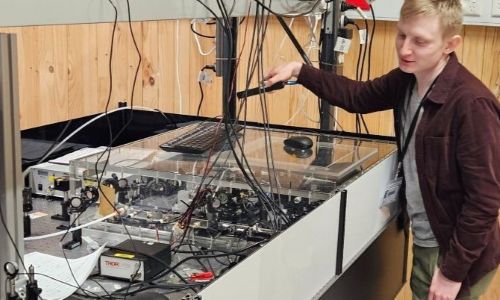
The team, led by Prof. Fabio Sciarrino, Associate Professor at Sapienza University of Rome, Italy, built a modular QCNN using single photons from a quantum-dot source and two integrated quantum photonic processors. Like a classical CNN, the network processes information in stages. After the first stage, part of the light signal is measured.
Depending on the result, the system either injects a new photon or sends the existing light forward, gently steering the computation. Because today's photonic hardware cannot switch light in real time without losing information, the researchers emulated this step in the lab using a controlled technique that reproduces the same effect.
To test the design, they encoded simple 4 x 4 images-patterns of horizontal or vertical bars. Measurements at each stage matched theoretical predictions. In the full experimental setup, the QCNN achieved a classification accuracy above 92 percent, consistent with numerical simulations. This demonstrates the potential of the adaptive approach.
The researchers also explored scalability, noting that future photonic devices with fast switching could enable larger, more powerful QCNNs that outperform some classical methods.
"This work provides both a theoretical framework and a proof-of-concept implementation of a photonic QCNN," says senior author Fabio Sciarrino. "We expect these results to serve as a starting point for developing new quantum machine learning methods."
By adding a simple adaptive step that works with existing technology, the study outlines a realistic path toward more capable photonic quantum processors.
The research was funded by the following institutions: European Union's Horizon Europe research and Innovation Program Under EPIQUE Project, ERC Advanced Grant QU-BOSS (QUantum Advantage via Nonlinear BOSon Sampling, ICSC-Centro Nazionale di Ricerca in High Performance Computing, Big Data and Quantum Computing, Funded by European Union-NextGenerationEU, EPSRC Quantum Advantage Pathfinder Research Program Within the UK's National Quantum Computing Center.
• This article was first published on spie.org.

Diffraqtion aims high with $10M for 'quantum' camera platform
September 01 2026