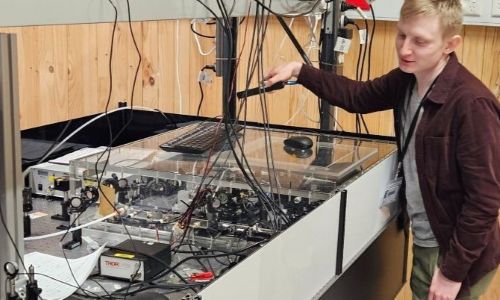



Sichuan University tunes laser to target pancreatic tumors
Femtosecond laser acts on collagen for selective ablation leaving healthy tissue intact.
08 October 2025 Research & Development
 A new laser-based technique targeting pancreatic ductal adenocarcinoma (PDAC) could be a significant new line of therapy for the most common type of pancreatic cancer.
Developed at China's Sichuan University, the technique employs selective laser ablation to treat PDAC while leaving surrounding healthy tissue unaffected.
Thermal ablation of PDAC has been investigated as a treatment before, but "existing methods such as radio-frequency, microwave, and laser ablation all lack the ability to selectively ablate cancerous tissue while preserving healthy pancreas," said the project team in its Optica paper.
The new method relies on a femtosecond laser tuned to the resonant mid-IR wavelength of collagen, the protein known to be a potential biomaker for pancreatic tumors. A recent project at the University of Arizona using multi-photon microscopy as an imaging tool for pancreas malignancies also used collagen as a key target.
"Our technology, for the first time, utilizes the tumor's molecular fingerprint to achieve selective ablation," said research team leader Houkun Liang from Sichuan University.
"We found that because PDAC contains substantially more collagen fibers than healthy pancreatic [tissue], using a mid-infrared laser at a wavelength strongly absorbed by collagen fibers can ablate the cancerous tissue while preserving the healthy pancreas."
Collagen's strongest infrared absorption peak is located at 6.1 microns, with lower peaks for normal tissue than for tumor tissue. As a result, tuning the wavelength of a mid-IR laser to align with the collagen resonance mode can preferentially target the tumor tissue.
Using molecular fingerprints to reduce collateral damage
To deliver the femtosecond laser light, the project developed a new anti-resonant hollow-core fiber with an outer diameter of less than 400 microns and bending losses below 1 dB/m at radii under 10 centimeters.
This should enable reliable delivery of laser light deep inside the human body, and for enhanced clinical use it could be equipped with a biocompatible medical-grade polyimide jacket and sapphire endcaps, ensuring durability and minimizing the risk of breakage inside the body.
In trials comparing the selective ablation of surgically removed human PDAC tumors with that of normal pancreatic tissue, the project successfully observed two to three times higher ablation efficiency in PDAC, according to its paper. The growth rate of cultured PDAC was suppressed to 1/8th of that observed in a control group.
The next steps could include integrating OCT into the system to perform cancer examination and ablation simultaneously, along with studying applicability of this technology to other tumor types with different molecular signatures. Melanomas, breast tumors and gastric cancers, among others, also contain abundant collagen, noted the team.
"Our broader project aims to develop a laser-based surgical platform that uses molecular fingerprints to reduce collateral damage and guide selective ablation," said Houkun Liang.
"There is an urgent clinical need for safer and more precise treatment options for various cancers and tumor types, eye diseases and atherosclerosis, and this can be accomplished by using a laser wavelength that precisely matches specific biomolecular absorption features."

Diffraqtion aims high with $10M for 'quantum' camera platform
September 01 2026