 |

26 Mar 2026
Two-photon lithography process leads to enhanced physical properties.
A project at Caltech has fabricated 3D metallic pieces with nanoscale structures using a two-photon lithography process.Described in Nature Communications, the manufacturing principle could now be applied to the creation of items for medical devices and space missions, among other applications.
The process can work with any metal or metal alloy, according to Caltech, and yields components of surprising strength despite having porous and defect-ridden microstructures.
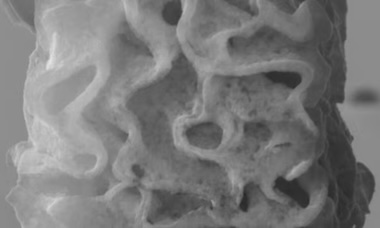
The procedure starts by using a tightly focused femtosecond laser beam to build a desired shape out of a light-sensitive polymer, making high-fidelity 3D polymer templates. After infusing the miniature "organogel" sculpture with metallic salts such as copper nitrate or nickel nitrate, the structure is heated twice in a specialized furnace.
The first heating cycle burns off the organic material, leaving the metal oxide. Items for certain end uses might be complete at this stage, but for others a second thermal step using different furnace gases removes oxygen from the oxides, to leave a structure formed of only the desired metal.
"Because of this thermal process, there's a tremendous amount of shrinkage," commented Caltech's Julia Greer. "The process can reduce the preheated volume by as much as 90 percent, yielding tiny lattices for heat exchangers, for example, with overall dimensions smaller than 50 microns and building blocks measured in nanometers."
Modeling custom nanostructured parts
The nanostructures made by this process proved to contain numerous flaws, such as pores, grain boundaries, and even inclusions or impurities. These would normally make a metallic part weak and susceptible to failure.
But in this case Caltech modeling predicts mechanical strengths that might be up to 50 times greater than that expected from the same metals with larger dimensions and similar microstructures, thanks to the cumulative structural effect of the nanoscale organization made through lithography.
"The produced nickel nano-architectures exhibit remarkable specific mechanical strengths, surpassing the fabrication precision, structural complexity and mechanical robustness limitations of prevailing metal additive manufacturing methods," wrote the project in its paper.
Julia Greer stressed that these modeled results were not inferences, but derived directly from the specific nanoscale structures created via lithography.
"I think this work basically shows that in the future, even when we 'nano-architect' our world with custom parts, we'll be able to reliably predict their properties, something society hasn't been able to accomplish yet," said Greer. "And we don't have to disqualify a part simply because it contains defects."
 |  |  |  |  |  |  |
| © 2026 SPIE Europe |
|