 |

04 Mar 2026
UCL London project conducts 3D tree census to better understand biomass that forests contain.
Highly detailed 3D scans of dense tropical rain forest plots are enabling precise estimates of tree structure, volume and stored carbon, as part of a first-of-its-kind pilot initiative, led by researchers at University College London, (Department of Geography at UCL).Described in a paper in Earth System Science Data, the finalised full dataset of the 3D tree census is helping scientists better understand how much biomass (or plant material) forests contain, an important step in understanding how much carbon is stored across the entire forest.
By providing ground-based measurements, the work is also helping improve satellite-based forest monitoring, which is used to track how forests are responding to climate change. Satellite missions can use the study’s benchmark data to refine their algorithms and improve global biomass mapping.
The UCL-led project, called ForestScan, is part of a bigger international initiative called GEO-TREES. Together, these teams are building a global network of special forest sites where scientists can measure trees and forest structure very accurately, focusing on the amount of biomass and hence carbon, stored in them. These sites are called Forest Biomass Reference Measurement Sites (FBRMS).
For this study, the researchers focused on three tropical rain forested regions around the world: Paracou in northern French Guiana, Lopé National Park in central Gabon and Kabili-Sepilok Forest Reserve in northeast Malaysia.
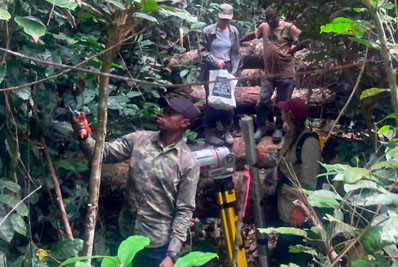
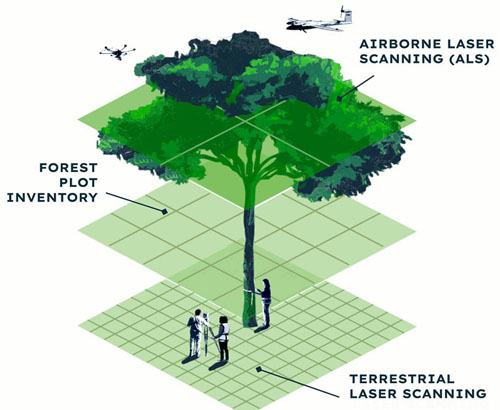
Airborne and UAV-mounted laser scanners measured representative plots within these regions totalling nearly 550 hectares (about two square miles), recording data on more than 200,000 individual trees. Working closely with local scientists and researchers in each country, the team collected more detailed data by hand-measuring, tagging and ground scanning about 7,000 trees in sub-divisions within these plots.
Lead author Dr Cecilia Chavana-Bryant (UCL Geography) said: “Accurate forest biomass data is essential for understanding how forests store carbon and respond to climate change.
“By combining advanced 3D scanning technologies across three continents, we have created one of the most detailed datasets ever collected for tropical forests – providing a benchmark for satellite missions and Earth observation tools. This work lays the foundation for more reliable global forest monitoring, helping scientists, policymakers, and conservationists make informed decisions about protecting forests and tackling climate change at both local and global scales,” she said.
How ForestScan worksAt each site, the researchers used laser scanners to generate 3D models of every tree within the selected plots. To achieve the most comprehensive scans within these areas, they used a combination of techniques:
Dr Chavana-Bryant, added: “This was a tremendous undertaking. It has resulted in the most detailed dataset ever collected for these forest areas, helping us better understand and characterise forests globally. By using a diverse set of tools in ForestScan, we have achieved exceptional accuracy in our data and gained valuable insights into the real-world challenges of collecting field measurements at this scale.”
Accurately measuring forest biomass is increasingly important, as forests play a key role in removing the greenhouse gas carbon dioxide from the atmosphere. Forest plants and trees absorb carbon to grow, storing it in their trunks and branches. Around half of a tree’s living mass is made up of carbon drawn from the atmosphere.
Knowing the precise amount of forest biomass, and therefore the quantity of stored carbon, is particularly important for the emerging carbon offset market, where organisations pay to plant new forests or protect threatened forested areas to offset their carbon emissions.
In addition, accurately knowing a forest’s biomass helps researchers estimate the amount of carbon released due to fire or illegal logging. Much of the uncertainty surrounding carbon offsetting stems from a lack of accurate ground data to train the deep learning and AI models increasingly used to make predictions of forest carbon.
 |  |  |  |  |  |  |
| © 2026 SPIE Europe |
|