



Flexible optical fiber offers improved larynx surgeries
Worcester Polytechnic Institute expands outpatient laser treatment options for patients.
15 April 2026
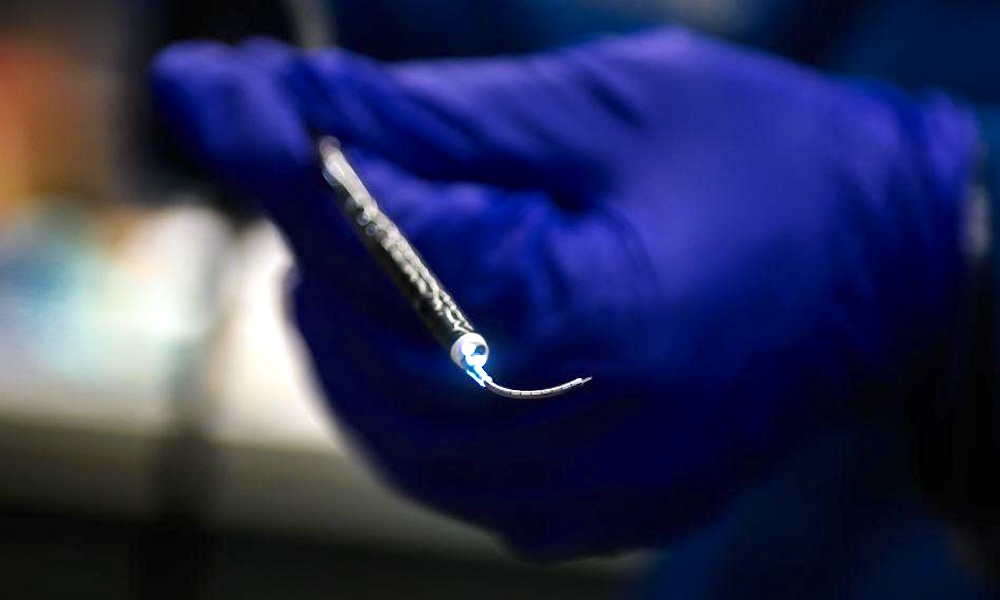
A flexible optical fiber in the laboratory of Loris Fichera. Credit: Worcester Polytechnic Institute.
A project at Worcester Polytechnic Institute (WPI) has developed flexible optical fiber technology intended to offer new routes to laser-based larynx surgery.
The optical fiber can be threaded through a medical endoscope and steered into the larynx to destroy hard-to-reach tumors on the vocal folds, an advance that could expand outpatient laser treatment options for patients whose only other choice might be surgery under general anesthesia.
The researchers reported that during tests with a 3D-printed replica of a human larynx, they were able to reach targets that otherwise would be impossible to get to during outpatient treatments.
Laser surgery of the vocal folds is typically done to remove tiny benign or precancerous growths such as callus-like nodules and polyps. Procedures commonly involve an endoscope fed through the nostril of a patient, although growths harder to reach can be treated in a hospital under general anesthesia.
"Some people, such as patients with cardiac conditions, may not be able to undergo general anesthesia and conventional laser surgery for growths in the larynx," said Loris Fichera from the WPI Cognitive Medical Technology Laboratory. "An improved medical device could address that problem by giving some patients an option to undergo laser treatment while under mild sedation in medical offices instead."
Previous work at WPI designed a steerable laser fiber combining a thin optical fiber and a tendon-actuated nickel-titanium notched sheath of 1.6 millimeters diameter that provides bending, with the goal being a device flexible enough to be compatible with commercially available endoscopes.
Reaching the parts other endoscopes cannot reach
The new WPI design, described in Journal of Medical Devices, builds on the principle to create a sheath thin enough to fit into an endoscope with a light and camera on the tip, which can then be inserted into the body to examine tissues, organs, and structures.
Once inside an endoscope, the sheath and optical fiber can be steered with hand-held controls to a site in the voice box and vocal cords, to destroy growths with pulses of light.
In trials the researchers used 3D printing to build an anatomically correct model of a real human larynx, and plotted 70 points on the model that could not be reached with non-steerable optical fibers. Using the new steerable tool, 57 of those difficult targets, or about 81 percent, were successfully reached, suggesting that a steerable fiber significantly expands surgical access.
Although the device created by the WPI team could expand office-based procedures for laser surgery of the larynx, Loris Fichera says that more research and development of the device is needed. The rigid 3D-printed model could not replicate the movements that occur when a patient is being treated, and the device currently requires two operators working together. Improvements might make it possible for one operator to use the device.
"Much of the fundamental research has been completed," Fichera said. "We are planning a follow-on project to make improvements that would allow the optical fiber to bend in different directions and curve to reach more places. Ultimately, our goal is to help as many patients as possible by expanding options for office procedures."



MetaOptics looks to expand US production with $10M warrant deal
September 22 2026

Attalon invests $15M in high-energy laser capacity
September 16 2026

ams Osram unveils imaging-to-display sensor for smart phones
September 16 2026

Spectroscopy can enable earlier detection of pelvic organ prolapse
September 16 2026