



China team develops skin hydration sensor for use at home
Dual wavelength near-IR diffuse reflectance registers deep-skin water content.
08 July 2026
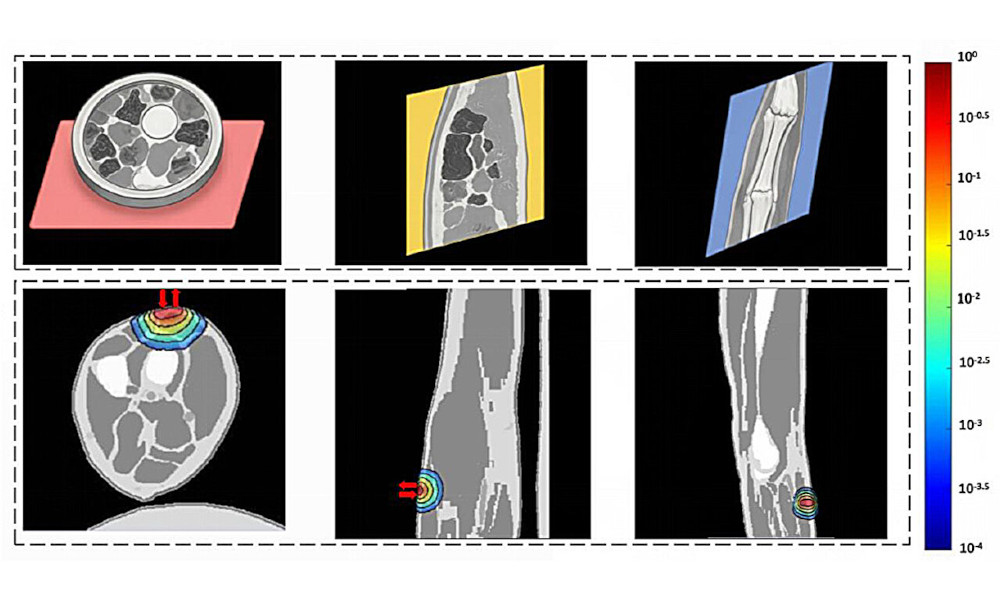
Near-infrared optical measurements combined with a temperature-aware algorithm create an at-home skin hydration monitoring system that fills key gaps in skin care management. Credit: Yisong Xue/APL Photonics.
A project group involving the Chinese Academy of Medical Sciences, Characteristic Medical Center of Chinese People’s Armed Police Force in Tianjin, and Cardiff University, has developed a compact near-IR sensor device intended to simplify assessment of skin hydration levels.
Published in APL Photonics the findings point to more convenient non-invasive home-based monitoring of hydration levels for people managing atopic dermatitis (AD), a type of eczema.
Hydration is a key factor for the progression of AD, and maintaining a healthy level of skin hydration reduces discomfort and the spread of the condition. But current hydration assessment methods are often limited by poor subsurface sensitivity, optical interference from surface lesions and environmental noise, commented the project, all hindering portable real-time testing.
"Skin hydration matters a great deal in atopic dermatitis, but the tools used to assess it are still not ideal," said Ting Li, a researcher at the Chinese Academy of Medical Sciences & Peking Union Medical College. "For a person with chronic dry or inflamed skin, the ideal outcome is simpler and more objective monitoring: Instead of relying only on how the skin feels that day or waiting for clinic visits, they could have access to a fast, noninvasive way to track whether their skin hydration state is getting worse or better."
Seeking such a test, the researchers turned to near-IR spectroscopy, already employed in other scenarios for the detection of O-H bonds in water, but often in instrumental platforms of significant size and complexity. More portable platforms have tended to suffer from measurement drift, and be hindered by the temperature-dependent nature of skin optical response.
Diffuse reflectance spectroscopy, in which light diffusively reflected from different layers in the skin is collected for analysis, provided the solution. A dual-wavelength 910 and 970 nanometer platform was designed around a bespoke probe geometry, ensuring that the sensing volume was tailored to capture subsurface hydration changes relevant to AD pathology rather than being restricted to the skin surface.
Designing a system for complex tissues
The 970 nanometer channel serves as the primary water-sensitive signal, rather than more strongly absorbed bands at longer IR wavelengths, to ensure sufficient photon penetration and signal-to-noise ratio, noted the project. Combining fixed-geometry acquisition with a temperature-aware regression algorithm significantly improved the system’s robustness against intensity fluctuations and thermal drift.
The data was used to calculate a novel parameter termed the optical hydration index (OHI) to serve as a digital biomarker. combining multiple inputs and measurements to gain a more comprehensive picture of the state of the skin.
"With temperature changes, water absorption behavior can shift, tissue optical properties can vary, blood flow can change, and tissue microstructure can subtly alter light scattering," Li said. "That is why temperature was a key part of our design. We measured skin-surface temperature and included it in the regression model, which improved stability and reduced one of the important sources of real-world measurement variability."
In trials the new platform was validated through ex vivo porcine skin dehydration experiments and benchmarked against commercial instruments in vivo. The results demonstrated that the OHI effectively distinguishes AD patients from healthy individuals with high diagnostic accuracy, according to the project, and sensitively tracks short-term dynamic hydration changes following emollient application.
"The main goal was to create a compact, noninvasive hydration-sensing system that would be more robust than conventional superficial methods and still practical enough for repeated use," Li said. "Real skin is biologically complex, and a useful clinical signal often comes not from pretending the tissue is simple, but from designing a system that remains stable despite that complexity."
Boston University tracks water dynamics during hemodialysis
February 11 2026

Singular launches programmable single-photon sensor
September 10 2026
EPFL enhances super-resolution imaging from single camera exposures
September 09 2026
Stuttgart-led group combines illumination and microscopy in fiber bundle
September 09 2026

ESA Earth observation mission FLEX set to launch on September 15th…
September 09 2026