



New class of miniaturized spectrometer suits wearables, costs $10
University of Cambridge demonstrates low-cost sensor device for portable devices.
10 June 2026
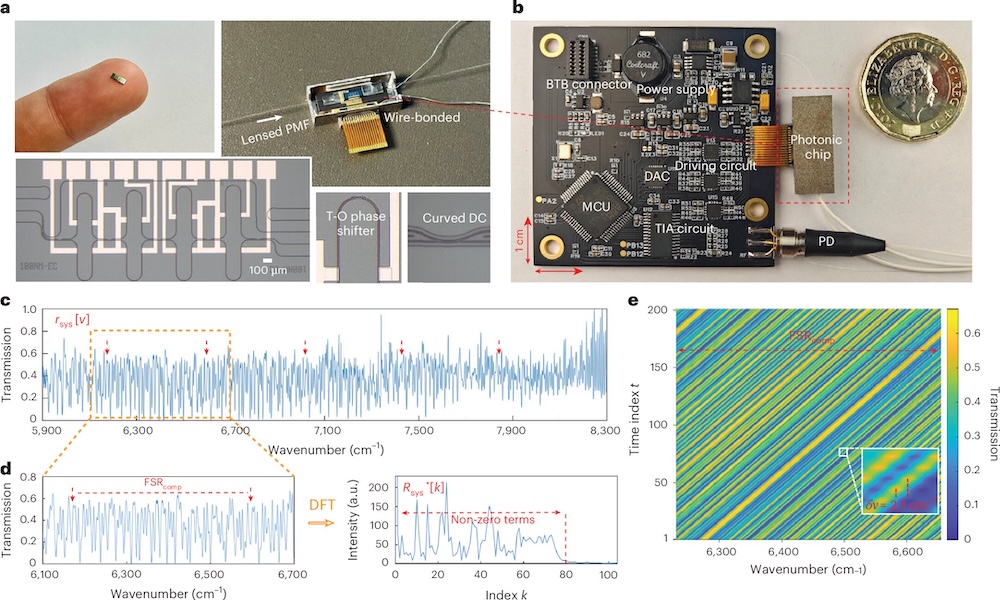
Chip fabrication, packaging and characterization. Credit: University of Cambridge/Nature Photonics.
A team from the University of Cambridge and its associated spin-out company GlitterinTech has demonstrated a fundamentally new type of optical spectrometer, in a device small enough to be embedded into portable and wearable technologies.
As described in Nature Photonics the device is said by the team to cost only around $10, potentially opening up new applications in industrial quality control and real-time healthcare monitoring.
Shrinking spectrometer instruments has historically involved painful trade-offs, noted the project. Miniaturized devices typically sacrifice bandwidth, resolution or accuracy, limiting them to rough identification rather than true metrological measurements.
"The new convolutional spectrometer overcomes these barriers by introducing a conceptually elegant operating principle grounded in the convolution theorem, offering unprecedented performance metrics compared with existing dispersive, Fourier-transform and reconstructive spectrometers," said the group.
The convolution theorem is a principle in signal processing and Fourier analysis, already useful in filtering signals or enhancing edge detection in image processing. In the Cambridge implementation, a convolutional spectrometer (ConvSpec) executes this processing operation on an input spectrum via a cascade of optical components with periodic spectral responses, such as micro-ring resonators.
By proportionally tuning these components, the system linearly shifts its spectral response, enabling accurate spectrum recovery using fast Fourier transforms.
"The key insight was to go back to the mathematics and ask whether there was a fundamentally cleaner way to retrieve spectra," said Chunhui Yao from Cambridge and GlitterinTech. "By using the convolution theorem directly in the optical domain, we avoid many of the limitations that have held miniaturized spectrometers back. This gives us high precision, strong noise tolerance, and very low computational overhead, all in a compact and low-cost system."
Make spectroscopy as ubiquitous as temperature or motion sensing
The project implemented this architecture on a silicon nitride photonic integration platform, creating a device operating across an ultra-wide near-IR range of 1200 to 1700 nanometers with sub-second sampling and processing times. Crucially, its periodic nature allows an almost unlimited bandwidth expansion in the spectral domain without changing the hardware, commented the project.
"Our device achieves a centimetre-scale overall footprint, a sampling and local processing time of under 0.4 seconds and a total cost of around US$10."
In trials across a range of real-world applications, the device classified plastics, pharmaceuticals, coffee, flour and tea with a 100 percent success rate. It also quantified concentrations in aqueous and organic solutions with accuracies of around 0.01 percent, outperforming commercial bench-top spectrometers according to the team.
Tests on biological samples showed that the sensor could also detect human biomarkers under realistic physiological conditions, including skin moisture, blood alcohol, blood lactate and blood glucose. The glucose tracking was demonstrated over extended periods in a single participant.
These biomedical demonstrations were particularly exciting, noted the team, with potential healthcare applications ranging from hydration assessment and intoxication alerts to fitness tracking and continuous glucose monitoring for diabetes management. In other sectors low-cost, high-precision ConvSpec devices could enable smart sensors across manufacturing lines, real-time food quality monitoring and environmental analysis at an unprecedented scale.
"Our vision is to make spectrometry as ubiquitous as temperature or motion sensing," commented project leader Qixiang Cheng. "This work shows that high-quality spectral information doesn't have to be confined to the laboratory; it can be embedded directly into the technologies people use every day."
Miniature spectrometer offers novel endoscopes and cameras
February 10 2021

Leica and Cognex launch AI software module Aivaro to improve inspection
September 30 2026

Photonic monitoring to identify food safety, quality, and animal welfare
September 30 2026
Advances in optics and computation boost coronary intravascular imaging
September 30 2026

Australia’s SKA tests antenna layout for Low telescope
September 30 2026

Artemis merges Optikos with Omega Optical
September 30 2026