


ASML drops on 2026 growth fears
But the semiconductor lithography giant says tariff impact is not as bad as anticipated so far.
16 July 2025 Business News

The stock price of key chipmaking equipment provider ASML has dropped by around 8 per cent, after the company's CEO said that he could no longer confirm that business would grow in 2026.
Although sales remain on track to rise by approximately 15 per cent this year - to around €32.5 billion - Christophe Fouquet said in a release announcing the Dutch firm's latest financial results:
"Looking at 2026, we see that our AI customers' fundamentals remain strong. At the same time, we continue to see increasing uncertainty driven by macroeconomic and geopolitical developments. Therefore, while we still prepare for growth in 2026, we cannot confirm it at this stage."
In a video interview posted on ASML's web site, Fouquet and CFO Roger Dassen highlighted the ongoing uncertainty surrounding US-imposed tariffs and retaliatory measures, and how they could impact shipments of ASML's complete systems, components, and field upgrades directly, plus the wider effect on business confidence.
"Quite frankly, it's all very uncertain," Dassen remarked. "Both the direct and the indirect impact are still very uncertain. So, we just have to navigate that as best as we can."
However the CFO did also comment that, at least for the second quarter of 2025, the tariff impact turned out to be "a bit less negative than anticipated".
EUV throughput upgrades
For that quarter, which ended June 29, ASML posted sales of €7.69 billion, up from €6.24 billion in the same period last year, with profit margins boosted by field upgrades of "NXE:3800" extreme ultraviolet (EUV) lithography systems to the final throughput specification of 220 wafers per hour (WPH).
That represents a 37 per cent productivity increase for the upgraded tools, with Fouquet saying that ASML was on track to complete all of those upgrades by the end of the year.
"This tool, thanks to [its] higher productivity, really allows customers to shift more multi-patterning layers to single exposure," he explained. "So this allows customers to reduce complexity, reduce yield loss, [and] improve cycle time."
All those upgraded EUV tools are based around the initial "low numerical aperture" (low-NA) optics provided by key partner Zeiss, with the next-generation "high-NA" platform now starting to roll out.
"For [high-NA], we have shipped our first EXE:5200, which is the tool that is going to be used in high-volume manufacturing," Fouquet said. "The tool is under installation [and] will provide our customers with 60 per cent productivity improvement compared to the EXE:5000. So we're talking about 175 WPH."
While next year's sales outlook now appears uncertain, Fouquet stressed that the longer-term picture remained positive, with the company maintaining its earlier expectation that in 2030 it could post revenues of anywhere between €44 billion and €60 billion.
• Following ASML's results announcement the company's stock price dropped in value by around 8 per cent in pre-market trading on the Nasdaq. Set to open at around $750, it equates to a market capitalization in the region of $300 billion.
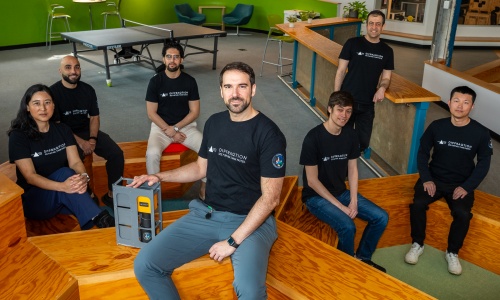
Diffraqtion aims high with $10M for 'quantum' camera platform
September 01 2026