 |

17 Sep 2025
Fine-tunes solar gain in real time and protects itself against environmental contaminants.
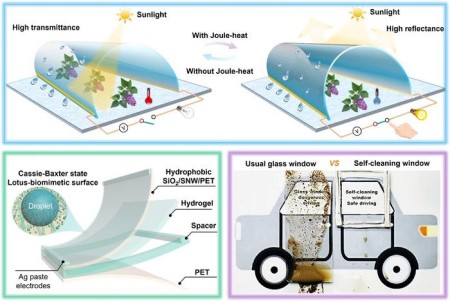
A research team at Hefei University of Technology (HFUT), China, has developed what it calls all-flexible, self-cleaning smart window that not only fine-tunes solar gain in real time but also protects itself against environmental contaminants — even on curved or 3D surfaces.The work is described in the International Journal of Extreme Manufacturing.
The group says that their findings “could accelerate the development of green buildings and water-resistant vehicles, addressing two of the world's most pressing challenges: rising energy demand and global carbon emissions.”
Windows are often the weakest point in a structure’s energy efficiency, accounting for nearly 40% of heat loss in buildings. Traditional smart windows can regulate solar transmittance, but their real-world performance has been limited thus far by poor flexibility, low portability, and inadequate resistance to liquids, according to the Hefei team.
Sustainable building systems
“Smart windows that can repel diverse liquids are highly attractive for sustainable building systems,” said Prof. Chao Chen, corresponding author and Assistant Professor at HFUT’s School of Materials Science and Engineering. “But most devices so far have lacked robust hydrophobicity and design versatility. We asked ourselves: why not engineer a flexible, multi-layer structure that integrates all of these functions into one system?"
The HFUT team designed a multi-layer hydrogel smart window that sandwiches a hydrophobic silver nanowire heater with a thermo-responsive hydrogel (LCST ~ 30 °C). When triggered by a small electric current, the hydrogel rapidly shifts between transparent and opaque states, regulating light and heat. Unlike previous prototypes, the material is flexible enough to be applied to both flat and three-dimensional surfaces.
The device’s superhydrophobic interface repels a wide range of liquids, from water to organic solvents, and offers built-in self-cleaning capabilities. The researchers also demonstrated the system not only for solar control and thermal management but also for defogging, encrypted display, and 3D portable envelopes—applications that stretch far beyond traditional smart windows.
“The biggest advantage of this type of multifunctional window is that one device can do many things—solar control, demister, encryption–decryption, or even 3D self-cleaning envelopes,” said Prof. Chen. “In the face of today’s energy crisis and global warming, multifunctional solutions like this could prove essential.”
The study reflects two years of intensive research into fabrication methods, solar-switching behavior, electro-thermo-light dynamics, droplet hydrodynamics, and self-cleaning performance. The group is now working to improve the system’s durability under real-world stresses, including UV exposure, repeated use, and weathering.
The implications are significant, says the Hefei group: “If scaled successfully, such a window could become a tool for net-zero building design, water-resistant vehicle surfaces, and other sustainability-focused applications. In an era when energy crises and climate change are converging, multifunctional materials of this kind may prove indispensable.”
 |  |  |  |  |  |  |
| © 2025 SPIE Europe |
|