 |

25 Feb 2026
University of Massachusetts Amherst spin-out is working to scale production of wafer-level metaoptics.
Myrias Optics, a recent spin-out from the laboratory of Jim Watkins at the University of Massachusetts Amherst, says it has raised $2.1 million in seed funding.
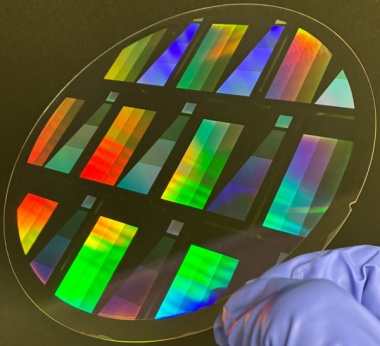
Specializing in wafer-level metalenses, AR waveguides, and diffractive optics, the startup company is looking to scale up production and expand its pilot-line activity with the proceeds, building on the strategic manufacturing partnership it signed with Baltimore-based Pixelligent last October.
The latest funding round, which follows a $3.3 million effort closed in December 2023, was led by local VC firm MassVentures, alongside additional support from existing investors Hoss Investment Inc., Maroon Venture Partners, and Tenon Venture Partners, plus new investors Mill Town Capital, TiE Boston Angels, and Doug Crane.
“With $6.9 million secured to date, Myrias is advancing commercialization of its proprietary all-inorganic additive nanoimprint platform and expanding production capacity to meet growing customer demand,” announced Myrias.
“The company serves customers in augmented reality, AI data centers, consumer electronics, industrial, and medical markets - applications that require durable, high-performance optical components manufactured with precision, repeatability, and cost efficiency.”
During last month's SPIE Photonics West event, Myrias said in a LinkedIn post that it was aiming to release AR waveguides and metaoptics with refractive indices between 2.3 and 2.6 in the second quarter of 2026 - opening the door to "ultra-wide field of view" AR headsets and what it called truly immersive user experiences.
Additive nanoimprinting
According to the firm, in each of its target markets system designers face a common bottleneck: the availability of advanced optical components offering high optical performance and environmental stability alongside scalable manufacturing economics.
Myrias says that it addresses this challenge through a wafer-level additive nanoimprinting approach that can be used to make thermally stable, all-inorganic optical components produced with high repeatability and at a significantly lower cost than conventional semiconductor-based processing.
“In AR systems, for example, the company's industry-leading refractive index for imprinted waveguides enables higher view angles while maintaining manufacturability at scale,” claims the startup.
“In AI data center environments, similar material and manufacturing advantages support improved optical coupling efficiency, alignment tolerance, and thermal robustness for high-speed optical interconnects.”
CEO John Fijol added: “This round reflects validation of both our technology and our execution roadmap. Our focus is on delivering production-ready inorganic metaoptics that solve real manufacturing bottlenecks across multiple optical markets.
“We are seeing strong engagement from customers seeking scalable, cost-effective solutions capable of meeting next-generation performance requirements.”
Co-founder Watkins, a professor of polymer science and engineering at Amherst, explained: “Traditional polymer-based optical manufacturing presents limitations in durability, thermal stability, and long-term reliability.
“By combining advanced metasurface design with robust inorganic materials and additive wafer-level processing, we are enabling optical components that meet the performance and supply chain demands of emerging AR, AI, and advanced imaging markets.”
Explosive growth expected
According to manufacturing partner Pixelligent, those applications are expected to help drive the market for metalenses from just over $40 million in 2024 to somewhere in the region of $2 billion by 2031.
“This explosive growth is driven by the demand for miniaturized, high-performance optical devices across numerous industries,” reported the company last year, citing consumer electronics, extended reality, optical communications, autonomous driving, medical devices, and aerospace as key sectors.
“Beyond the performance benefits, the ability to use a nanoimprint lithography process for mass production manufacturing creates significant cost and yield advantages when compared to traditional photolithography processes,” Pixelligent added. “By some estimates, the cost advantages are as great as 10:1.”
Myrias and Pixelligent have been collaborating since 2023, employing Pixelligent’s “PixClear” high-index materials to produce metalenses with refractive indices of up to 2.3, alongside more than 95 per cent transparency, thus minimizing haze and ensuring UV stability.
 |  |  |  |  |  |  |
| © 2026 SPIE Europe |
|